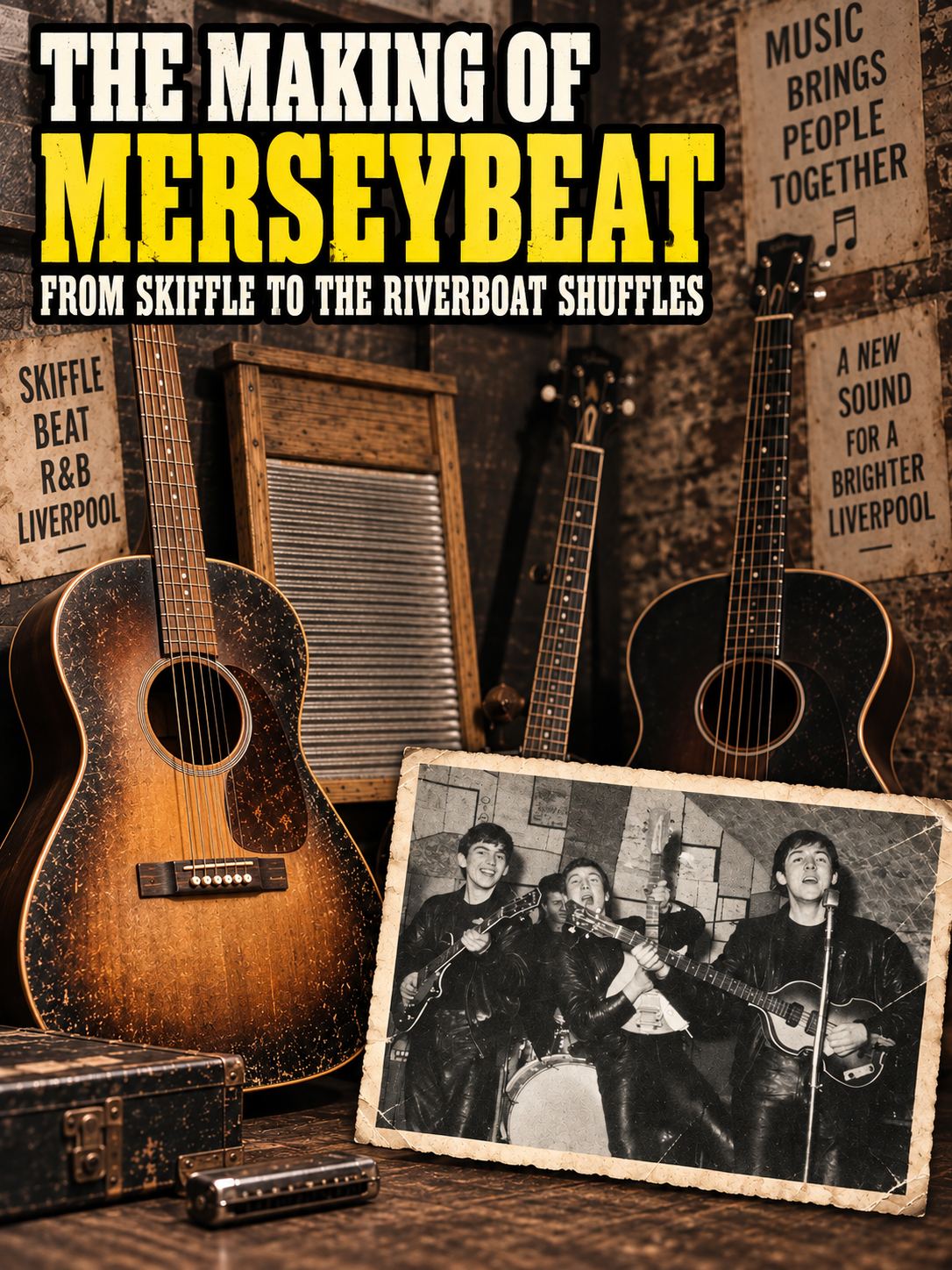
Before Beatlemania, before screaming crowds at airports and before Liverpool became shorthand around the world for a musical revolution, something extraordinary was already happening in the city.
Teenagers were forming groups in bedrooms, school halls, youth clubs and coffee bars. Guitars were bought on hire purchase. Washboards and tea-chest basses supplied rhythm when proper instruments were beyond reach. American rock ’n’ roll, rhythm and blues, country, jazz and vocal harmony were being absorbed and reworked by young Liverpudlians.
Cellars filled with music. Dance halls filled with teenagers. And out on the Mersey, bands even played aboard ferry boats.
Merseybeat did not suddenly appear with The Beatles. Liverpool built the scene that made The Beatles possible.
THE SKIFFLE EXPLOSION
To understand Merseybeat, we have to begin with Britain’s skiffle craze of the 1950s. Lonnie Donegan’s success helped turn a style rooted partly in American folk, blues and jazz traditions into a nationwide teenage phenomenon.
Skiffle was accessible. A teenager did not necessarily need expensive equipment or years of formal musical training: guitar, washboard and tea-chest bass could be enough to start.
Among the new groups was The Quarrymen, formed by John Lennon in 1956. On 6 July 1957, the Quarrymen played at St Peter’s Church fête in Woolton. That day Lennon was introduced to Paul McCartney. McCartney subsequently joined the group, followed by George Harrison.
But the Quarrymen were not developing in isolation. Across Liverpool and Merseyside, other young musicians were doing much the same thing. Skiffle provided the spark. Something louder was coming.

FROM WASHBOARDS TO ROCK ’N’ ROLL
British teenagers were increasingly listening to American performers including Elvis Presley, Little Richard, Chuck Berry, Buddy Holly and Carl Perkins, alongside rhythm-and-blues, country and vocal-group records.
Liverpool’s relationship with American music produced one of Merseybeat’s most persistent stories: that merchant seamen — often called the “Cunard Yanks” — returned from America carrying records unavailable anywhere else in Britain.
There is truth behind the broader picture. Liverpool seafarers travelled regularly to North America and some certainly brought records home. The disputed part is the stronger claim that Liverpool musicians therefore enjoyed unique access to American music unavailable elsewhere in Britain, and that this alone explains Merseybeat.
Researchers and Liverpool music historian Bill Harry have challenged later exaggerations of that story. American records reached Britain through several routes. The more convincing picture is of musicians absorbing many influences and turning them into something of their own. [1][2]
HUNDREDS OF GROUPS — ONE CITY
By the beginning of the 1960s, Liverpool possessed something more important than a handful of talented musicians. It had an ecosystem.
Groups competed for gigs and audiences. Promoters needed bands. Dance halls, clubs, youth venues and coffee bars needed entertainment. Fans developed loyalties. Musicians moved between groups, borrowed ideas, watched rivals and sometimes recruited one another.
Names including Rory Storm and the Hurricanes, Gerry and the Pacemakers, The Searchers, The Big Three, Kingsize Taylor and the Dominoes and many more became part of a scene far larger than the group that would eventually dominate its history.
Bill Harry’s contemporary Mersey Beat newspaper is one of the clearest surviving windows into that scale. Its pages were crowded with groups, advertisements, venue listings and local personalities. [2]
There was no single musical recipe called “Merseybeat”. Rock ’n’ roll sat beside rhythm and blues, country, skiffle, jazz and vocal harmony. What united the scene was Liverpool.
THE VENUES THAT MADE THE SCENE
The Cavern became the most famous address, but Merseybeat was not born in one cellar. Bands criss-crossed Liverpool and its surrounding districts playing halls, institutes, clubs and coffee bars.
The Casbah Coffee Club in West Derby is crucial to the story. Mona Best opened it in 1959, and the Quarrymen played on its opening night. Her son Pete Best later became The Beatles’ drummer before Ringo Starr joined in 1962. [3]
Litherland Town Hall became another important stage. After returning from Hamburg in late 1960, The Beatles appeared there in December. Other venues — including the Iron Door, Aintree Institute and numerous dance halls and social clubs — formed the circuit on which Liverpool groups learned how to hold an audience.
A music scene requires somewhere to play, somewhere to meet and an audience willing to come back next week.
THE CAVERN CHANGES ITS TUNE
The Cavern Club opened at 10 Mathew Street on 16 January 1957, primarily as a jazz club. As musical tastes changed, so did the Cavern.
Under owner Ray McFall, beat music became increasingly important. On 25 May 1960, Rory Storm and the Hurricanes — with Ringo Starr on drums — appeared at what the Cavern records as its first advertised beat night. [4]
The Beatles made their first advertised Cavern appearance under that name on 9 February 1961, after returning from Hamburg. John Lennon had already played the Cavern in the earlier Quarrymen era.
The Cavern’s wider importance was that it gave Liverpool bands somewhere to develop in front of demanding local audiences.

HAMBURG — AN INTENSIVE APPRENTICESHIP
The Beatles’ first Hamburg residency began in 1960. Night after night, young musicians were expected to entertain audiences for long sets in clubs around St Pauli. Other Liverpool groups also worked there.
It is too simple to say Hamburg “taught Liverpool bands to play”. The scene and competition already existed at home. Hamburg offered an unusually intensive professional apprenticeship: long hours, repeated performances, a rapidly expanding repertoire and constant pressure to command a room.
NEMS — RECORDS, RETAIL AND BRIAN EPSTEIN
The story of how Liverpool consumed music also runs through NEMS — North End Music Stores, the Epstein family business.
Brian Epstein managed the record department, placing him close to the records, tastes and buying habits of Liverpool’s young music audience. In November 1961, Epstein went to see The Beatles at the Cavern and subsequently became their manager.
NEMS therefore connects two sides of the story: Liverpool as a city buying popular music and Liverpool as a city beginning to export it.
BILL HARRY GIVES THE SCENE A VOICE
One of the most important figures was Bill Harry. On 6 July 1961, the first issue of his newspaper Mersey Beat appeared. It covered Liverpool’s groups, venues and personalities and helped turn a collection of individual bands into something recognisable as a local cultural phenomenon. [2]
“Merseybeat” is now routinely used for Liverpool’s early-1960s musical movement, but contemporary descriptions also spoke of the “Mersey Sound” and “Liverpool Sound”. Mersey Beat was Harry’s newspaper; only later did “Merseybeat” become firmly established as the convenient umbrella name.
Liverpool was writing about its own musical revolution before much of the country realised one was taking place.

BOB WOOLER, RAY McFALL AND THE CONNECTORS
The musicians naturally receive most of the attention, but Merseybeat depended on people who connected bands, venues and audiences.
Ray McFall provided a crucial stage at the Cavern. DJ and compère Bob Wooler became one of the scene’s great connectors: introducing acts, knowing the groups, comparing them and helping give Liverpool’s crowded circuit a sense of community and competition.
Bill Harry chronicled it. Brian Epstein professionalised The Beatles’ management. Promoters, venue owners, journalists, shopkeepers and — above all — paying audiences kept the machinery moving.
WHEN MERSEYBEAT TOOK TO THE MERSEY
Perhaps nothing captures the character of Liverpool’s early-1960s music scene quite like the Riverboat Shuffles.
Bands played aboard the Royal Iris while the vessel travelled along the Mersey. Before The Beatles were filling concert halls around the world, Liverpool teenagers could board a ferry and dance while emerging musicians performed on the river.
Mersey Ferries documents four Beatles appearances on Royal Iris Riverboat Shuffles: 25 August 1961, 6 July 1962, 10 August 1962 and 28 September 1962. [5]
They were not initially the biggest attraction: Acker Bilk topped two of the bills and Johnny Kidd and the Pirates another. By the September 1962 Shuffle, The Beatles — now with Ringo Starr — were the headliners.

1962 — SOMETHING WAS HAPPENING
By 1962, Liverpool had the bands, clubs, dance halls, audiences and its own music newspaper. The Beatles had Brian Epstein managing them.
After an unsuccessful audition for Decca, the group secured a recording contract with EMI’s Parlophone label and producer George Martin. On 5 October 1962, Love Me Do was released. Then came Please Please Me, and the momentum accelerated dramatically.
1963 — BRITAIN DISCOVERS LIVERPOOL
During 1963, Liverpool and Merseyside groups poured into the national charts. The Beatles achieved successive enormous hits. Gerry and the Pacemakers became the first act to reach number one in the UK with each of their first three singles. The Searchers scored major hits including Sweets for My Sweet.
National journalists descended on the city. Record-company representatives searched for Liverpool groups. What had developed locally over several years suddenly looked to outsiders like an overnight explosion.
The explosion was simply the moment everyone else noticed.
THE BEATLES WERE PART OF SOMETHING BIGGER
The scale of The Beatles’ later success can distort the story of Liverpool music before Beatlemania.
The Beatles emerged from a thriving musical environment. They competed with other Liverpool groups, shared stages with them, watched them, borrowed ideas and were watched in return. Ringo Starr himself came into The Beatles from Rory Storm and the Hurricanes.
Merseybeat was not four lads creating a scene. It was a scene capable of producing four lads like The Beatles.
MORE THAN ONE SOUND
Even the word “Merseybeat” can mislead. There was no strict musical formula. Rock ’n’ roll sat alongside rhythm and blues. Country music mattered. So did vocal harmony. Skiffle remained part of the movement’s ancestry, while jazz clubs supplied some of its early venues.
American music provided enormous inspiration, but Liverpool musicians interpreted those influences through their own groups, venues and audiences. What became labelled Merseybeat was therefore as much a cultural scene as a musical genre.
FROM LIVERPOOL TO THE WORLD
By the end of 1963, Liverpool had become internationally associated with popular music.
But beneath the global story lies a smaller and more revealing one: teenagers with cheap guitars; skiffle groups in Woolton; Mona Best’s Casbah in West Derby; packed nights at Litherland; NEMS record counters; Hamburg residencies; Bob Wooler at the Cavern; Bill Harry’s newspaper; and the Royal Iris moving along the Mersey with bands playing aboard.
Nobody sat down and designed Merseybeat.
Liverpool made it.
And by the time the rest of the world heard the noise, the city had already been dancing to it for years.
Citations
SOURCES & FURTHER READING
- University of Liverpool research repository. Research on Liverpool popular music and the development of Merseybeat, including discussion of sailors and American records. University of Liverpool.
- Bill Harry — Mersey Beat. Archive material and Harry’s account of the newspaper and Liverpool music scene. Mersey Beat archive.
- Casbah Coffee Club. History of Mona Best’s West Derby club and its place in the early Beatles story. Casbah Coffee Club.
- The Cavern Club — History. The Cavern’s development from jazz club to centre of Liverpool’s beat scene. Cavern Club.
- Mersey Ferries — The Beatles. Dates and bills for The Beatles’ four documented Royal Iris Riverboat Shuffles. Mersey Ferries.
- The Beatles Story. Background on The Quarrymen, early Liverpool performances and the development of The Beatles. The Beatles Story.
Continue the conversation
Share this Liverpool story
Follow Out in Liverpool or bring your own memories and knowledge to the Community Group.