Liverpool did not invent the railway. But in 1830, Liverpool helped prove how the modern railway could work.
On 15 September 1830, eight trains left Liverpool on a journey that became one of the defining moments of the Industrial Revolution.
Their destination was Manchester.
The new Liverpool & Manchester Railway connected one of Britain’s great ports with the rapidly expanding manufacturing districts of Lancashire. It brought together steam locomotives, passenger travel, freight, double track, timetabled operation and purpose-built railway infrastructure on a scale not previously attempted.
It was also the day Liverpool MP William Huskisson stepped onto the track at Parkside and was struck by Rocket.
His death became one of the most famous stories in railway history. But Huskisson’s tragedy was only one part of something much bigger.
The railway leaving Liverpool that morning helped establish the pattern from which the modern main-line railway developed.
THE PROBLEM BEGAN AT LIVERPOOL’S DOCKS
The Liverpool & Manchester Railway was not created simply because engineers wanted to experiment with steam locomotives.
There was a commercial problem to solve.
By the early nineteenth century, Liverpool was one of Britain’s most important ports. Huge quantities of raw materials were arriving at its docks, while Manchester and the surrounding Lancashire towns were becoming centres of textile production.
Cotton arriving through Liverpool needed to reach the mills inland. Manufactured goods then had to travel back towards Liverpool for export.
Much of that traffic moved by canal. For Liverpool merchants, this could mean high charges, delays and dependence on established canal interests.
One of the men who became central to the railway scheme was Joseph Sandars, a wealthy Liverpool corn merchant and one of its earliest promoters. In 1824 he published a pamphlet arguing that a railway could reduce the cost and time involved in moving goods between Liverpool and Manchester. [1][2]
The argument was fundamentally commercial: Liverpool needed a faster and more dependable connection with the industrial towns inland.
The railway that eventually emerged was therefore deeply connected with Liverpool’s extraordinary growth as a port.
A RAILWAY UNLIKE WHAT HAD GONE BEFORE
Railways were not new in 1830.
Tracks carrying wagons had existed for generations. Steam locomotives had already been demonstrated successfully, and the Stockton & Darlington Railway had opened in 1825.
So Liverpool cannot simply be described as the birthplace of “the first railway”.
The importance of the Liverpool & Manchester Railway is more specific.
Historic England describes it as the first inter-urban locomotive-hauled public railway designed from the outset as a common carrier of both passengers and freight. It also operated a timetabled passenger service alongside the transport of goods. [1]
In other words, many of the elements that became familiar features of the modern main-line railway were being assembled here into one working system.
Parliament authorised the railway in May 1826, with George Stephenson as chief engineer. The resulting railway stretched for about 31 miles between Liverpool and Manchester. [1][3]
BUILDING LIVERPOOL’S RAILWAY
Some of the railway’s most remarkable engineering was concentrated at the Liverpool end.
The line could not simply run straight into the centre of the town. Instead, a complex arrangement was created around Edge Hill.
The original Edge Hill Engine Station stood in a deep cutting and effectively marked the point where locomotive-hauled trains began and ended their journey.
From there, separate tunnels connected the railway with Liverpool.
One route climbed towards Crown Street, Liverpool’s original passenger terminus.
Another plunged beneath the town towards the docks.
That was the Wapping Tunnel.
More than two kilometres long, it descended from Edge Hill towards Liverpool’s dock estate so goods could be moved between the railway and the waterfront. Historic England identifies it as the world’s earliest railway tunnel driven beneath an urban area. It was opened ceremonially in 1829 and even became a gas-lit visitor attraction before growing railway traffic made public access unsafe. [1]
This is an important detail because the Liverpool & Manchester Railway did not originally run into Lime Street.
Lime Street station did not open until 1836.
In 1830, passengers used Crown Street Station. Returning trains stopped at Edge Hill and the incline towards Crown Street was worked by stationary steam engines and ropes. [1]
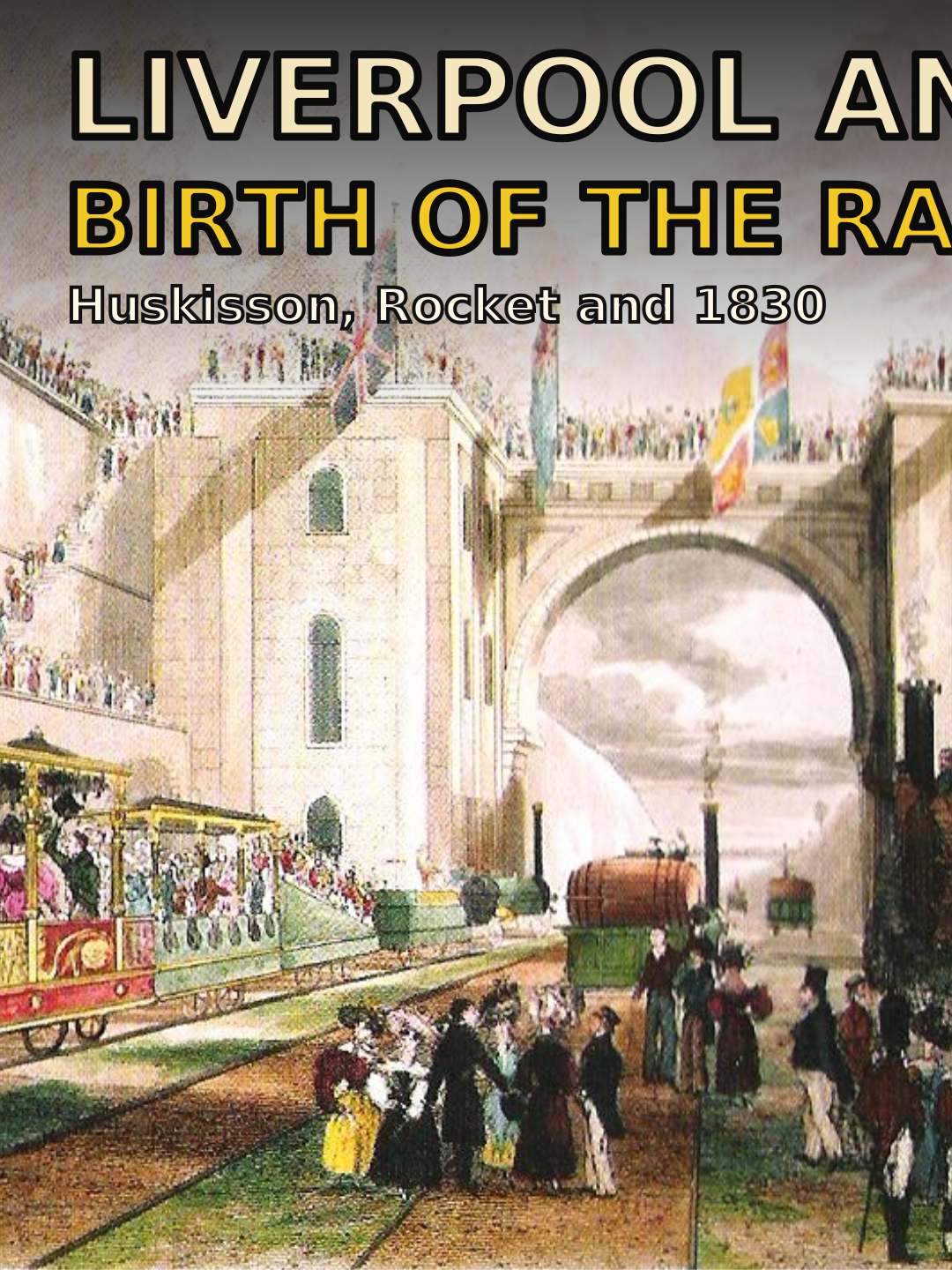
At Edge Hill stood the striking Moorish Arch, part of an elaborate railway complex designed to provide a suitably impressive entrance to Liverpool.
For passengers arriving in the town in 1830, this extraordinary piece of railway architecture formed part of the new railway landscape.
.jpg)
CROSSING CHAT MOSS
The engineering challenges did not end in Liverpool.
Between Liverpool and Manchester lay Chat Moss, a huge area of peat bog that many doubted could support a railway.
Instead of creating a conventional heavy embankment that would simply sink into the peat, Stephenson’s engineers spread the load across a broad foundation using brushwood, timber and other material.
The railway was successfully carried across the bog. A railway line still crosses Chat Moss today. [3]
RAINHILL DECIDES THE FUTURE
Even while the railway was being built, one major question remained unresolved.
What should pull the trains?
Locomotives were still relatively new technology. Stationary steam engines hauling trains by ropes were seriously considered for substantial parts of the railway.
To help settle the issue, the company organised the Rainhill Trials in October 1829.
Several different locomotive designs entered. The most successful was Rocket, built by Robert Stephenson & Company.
Rocket incorporated several important developments, including a multi-tube boiler that greatly improved the transfer of heat and helped produce steam efficiently. It was the only competing locomotive successfully to complete all the required trial runs. [4][5]
The importance of Rainhill was therefore greater than simply deciding which locomotive had won a competition.
The trials helped convince the railway company that mobile steam locomotives were practical enough for regular operation.

15 SEPTEMBER 1830
The ceremonial opening took place on 15 September 1830.
It was a national event.
Politicians, railway directors, engineers and invited guests gathered in Liverpool. Among them was the Prime Minister, Arthur Wellesley, Duke of Wellington.
Thousands of spectators lined sections of the route and eight trains formed the opening procession. At the head was Northumbrian, driven by George Stephenson and carrying Wellington and other distinguished guests. Rocket was among the locomotives taking part. [6]
For the people watching beside the track, the spectacle must have been extraordinary: large groups of passengers moving across the countryside at speeds few people had previously experienced.
The railway age was arriving in public view.
Then, roughly halfway between Liverpool and Manchester, celebration turned into catastrophe.
PARKSIDE
At Parkside, near Newton-le-Willows, the locomotives stopped to take on water.
Passengers had been warned not to leave their carriages.
Several did.
One of them was William Huskisson.
Huskisson was one of Britain’s most prominent politicians and had represented Liverpool in Parliament since 1823. He had served as President of the Board of Trade and had been involved in national debates surrounding commerce and free trade.
There was also political history between Huskisson and the Duke of Wellington. Huskisson had resigned from Wellington’s government in 1828.
At Parkside, Huskisson approached the Duke’s carriage.
The two men shook hands.
It appeared to be a public reconciliation.
Then Rocket approached on the adjacent track. [6]
THE ACCIDENT
Others standing between the trains managed to escape.
Huskisson did not.
Accounts differ in some of their finer details, but Huskisson became trapped in the path of the locomotive and Rocket struck him, catastrophically injuring his leg.
Almost immediately, the very technology being celebrated that day was used in an attempt to save him.
The injured Huskisson was placed aboard a carriage and George Stephenson drove him rapidly towards Eccles. Contemporary and later accounts identify the locomotive used as Northumbrian. [6][7]
Huskisson was taken into the vicarage at Eccles.
His injuries were beyond the medicine of the time.
He died later that evening.
WAS HUSKISSON THE FIRST PERSON KILLED BY A RAILWAY?
He is often described that way.
It is not strictly correct.
Fatal accidents connected with earlier railways had already occurred before September 1830.
Huskisson’s significance is different. The Science Museum Group describes him as the world’s first widely reported railway casualty. [7]
That distinction matters.
Huskisson was a nationally prominent politician. He was Liverpool’s MP. And the accident happened during one of the most heavily publicised technological events of the age.
Reports of his death travelled rapidly through Britain and beyond. For many people reading about railways for the first time, William Huskisson’s death became inseparable from the opening of the new railway.
DID THE OPENING STOP?
There was serious discussion about abandoning the remainder of the journey.
The Duke of Wellington was among those who favoured returning to Liverpool, but enormous crowds were already waiting in Manchester.
The organisers eventually decided to continue.
The trains moved on.
The mood was now completely different from the excitement with which the procession had left Liverpool.
The railway had demonstrated both its extraordinary potential and, in the most brutal way possible, the new dangers that accompanied high-speed mechanical transport. [6]
THE PUBLIC RAILWAY BEGINS
Another important distinction is often lost when the story is reduced to the date 15 September 1830.
That date was the ceremonial opening.
Ordinary passenger operation followed shortly afterwards.
The Science Museum Group records that passengers began travelling on the line two days later, on 17 September 1830.
Regular goods traffic followed on 1 December 1830. [4]
The railway was no longer an experiment or a grand opening spectacle.
It had become a working transport system.
LIVERPOOL’S ORIGINAL RAILWAY GATEWAY
Crown Street was soon overtaken by the railway’s own success.
Its location was inconvenient for many passengers wanting access to central Liverpool, and the facilities quickly became inadequate.
A new route was therefore constructed from a replacement Edge Hill station through another tunnel towards the town centre.
In 1836, Lime Street Station opened.
The original Crown Street passenger terminus lost its passenger role and subsequently became principally associated with goods traffic.
But the railway landscape created in 1830 did not completely disappear.
At the original Edge Hill site, parts of the cutting, tunnel portals, rock-cut chambers and archaeological remains of the engine station survive.
The Wapping Tunnel still extends beneath Liverpool.
Historic England designated the original Edge Hill Engine Station a Scheduled Monument in 2022, recognising its exceptional importance in the development of railway transport. [1]

LIVERPOOL REMEMBERS HUSKISSON
William Huskisson’s story also returned to Liverpool.
He was buried in St James’ Cemetery, the dramatic former quarry below what is now Liverpool Cathedral.
A substantial Greek Revival monument was later created there in his memory.
Designed by Liverpool architect John Foster, the monument was completed in 1836. It once contained a marble statue of Huskisson by sculptor John Gibson; Historic England records that the statue had been installed in the mausoleum by 1834, before the building’s final completion. [8]
The original marble was later removed after vandalism, but the monument itself survives in St James’ Gardens.
It remains one of Liverpool’s most tangible links to the drama of 15 September 1830.
WHAT REALLY MADE 1830 IMPORTANT?
The Liverpool & Manchester Railway was not the first railway.
Rocket was not the first steam locomotive.
Huskisson was not the first person ever killed in a railway accident.
Those simplified claims obscure what actually makes the story remarkable.
The achievement was the combination.
A major railway connecting two important commercial centres.
Steam locomotives operating regular services.
Passengers and freight carried on the same railway.
Double track.
Stations.
Timetabled operation.
Major tunnels, cuttings, embankments and bridges built specifically for railway traffic.
An organisation created to operate the whole system.
That combination helped demonstrate how railways could become a practical form of mass transport.
Other railway promoters watched closely. Engineers studied what had been achieved. Investment followed.
Within a generation, railway lines were spreading across Britain and then across much of the world.
AND MUCH OF THE STORY IS STILL HERE
Perhaps the most extraordinary thing about Liverpool’s role in the story is that it has not completely disappeared.
Beneath Liverpool is the Wapping Tunnel, driven towards the docks before the railway opened.
At Edge Hill survive parts of the original 1830 railway complex and the tunnel entrances that once connected locomotives, passengers and goods with Liverpool.
Below Liverpool Cathedral stands Huskisson’s monument.
And the railway corridor established between Liverpool and Manchester in 1830 remains part of the rail network.
These are not simply relics of an old transport system.
They belong to the moment when people were still working out what a railway actually could be.
On 15 September 1830, eight trains left Liverpool.
One passenger would not survive the day.
But the system being demonstrated around him would transform how cities traded, how people travelled, how quickly news and goods moved and, ultimately, how the modern world understood distance.
Liverpool did not invent the railway.
Liverpool helped show the world what the railway could become.
Citations
SOURCES & FURTHER READING
- Historic England — Edge Hill Engine Station, Liverpool & Manchester Railway. Detailed evidence for Edge Hill, Crown Street, the Wapping Tunnel, rope-worked inclines and the surviving 1830 railway archaeology. Historic England.
- Science Museum Group — Joseph Sandars and the projected Liverpool–Manchester railway. Background on the Liverpool merchant who became one of the railway’s earliest promoters. Science Museum Group.
- Institution of Civil Engineers — Liverpool & Manchester Railway. Engineering overview including the 31-mile route, Chat Moss and the railway’s wider significance. Institution of Civil Engineers.
- Science Museum Group — Liverpool & Manchester Railway. Railway history including the opening and the start of regular passenger and goods operations. Science Museum Group.
- Science Museum Group — Stephenson’s Rocket. Evidence for Rocket’s design and performance at the Rainhill Trials. Science Museum Group.
- The Gazette — The opening of the Liverpool and Manchester Railway, 1830. Contemporary evidence and later historical account of the opening procession and Huskisson’s accident. The Gazette.
- Science Museum Group — William Huskisson. Records Huskisson’s role, the Parkside accident and his status as the first widely reported railway casualty. Science Museum Group.
- Historic England — Huskisson Monument, St James’ Cemetery. Architectural and historical record of Huskisson’s Liverpool memorial. Historic England.
- Science Museum Group — The Opening of the Liverpool and Manchester Railway, 15 September 1830. Isaac Shaw’s 1831 engraving showing the Moorish Arch at Edge Hill. Science Museum Group.
Continue the conversation
Share this Liverpool story
Follow Out in Liverpool or bring your own memories and knowledge to the Community Group.