
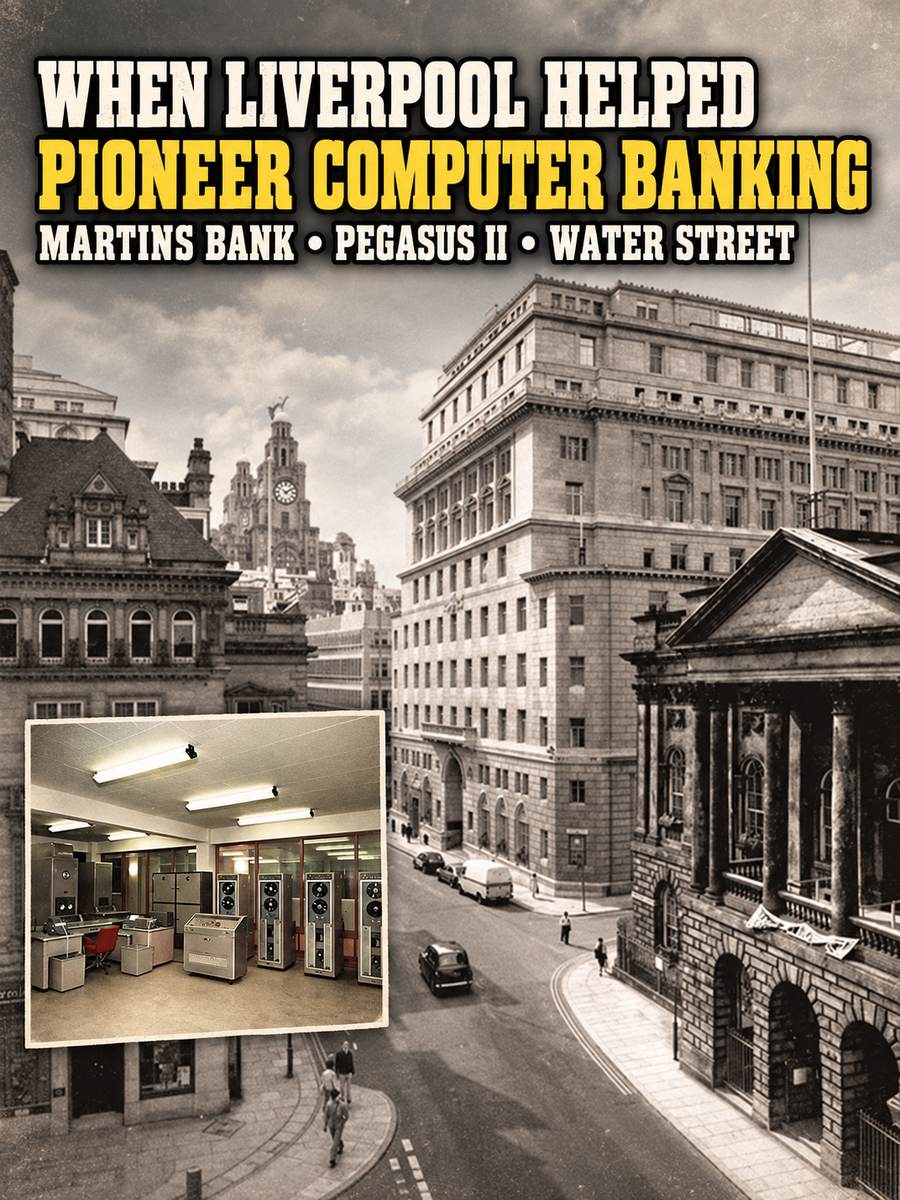
Walk along Water Street and Martins Bank looks like a monument to an older Liverpool.
Its vast stone façade and magnificent banking hall belong to a world of polished counters, handwritten ledgers, cheques and clerks working through mountains of paperwork.
Yet in the early 1960s, just yards from this great symbol of traditional banking, Martins was experimenting with something radically different.
A computer.
Not a desktop machine. Not a terminal sitting on a cashier's counter. This was a machine that needed its own specially prepared computer centre, magnetic-tape units, punched paper tape and a team of programmers and operators.
And Martins was using it for something especially significant: the everyday bookkeeping of customers' current accounts.
Liverpool was entering the computer age.
A BANK ROOTED IN LIVERPOOL
Martins Bank was unusual among Britain's major clearing banks because its headquarters were not in London.
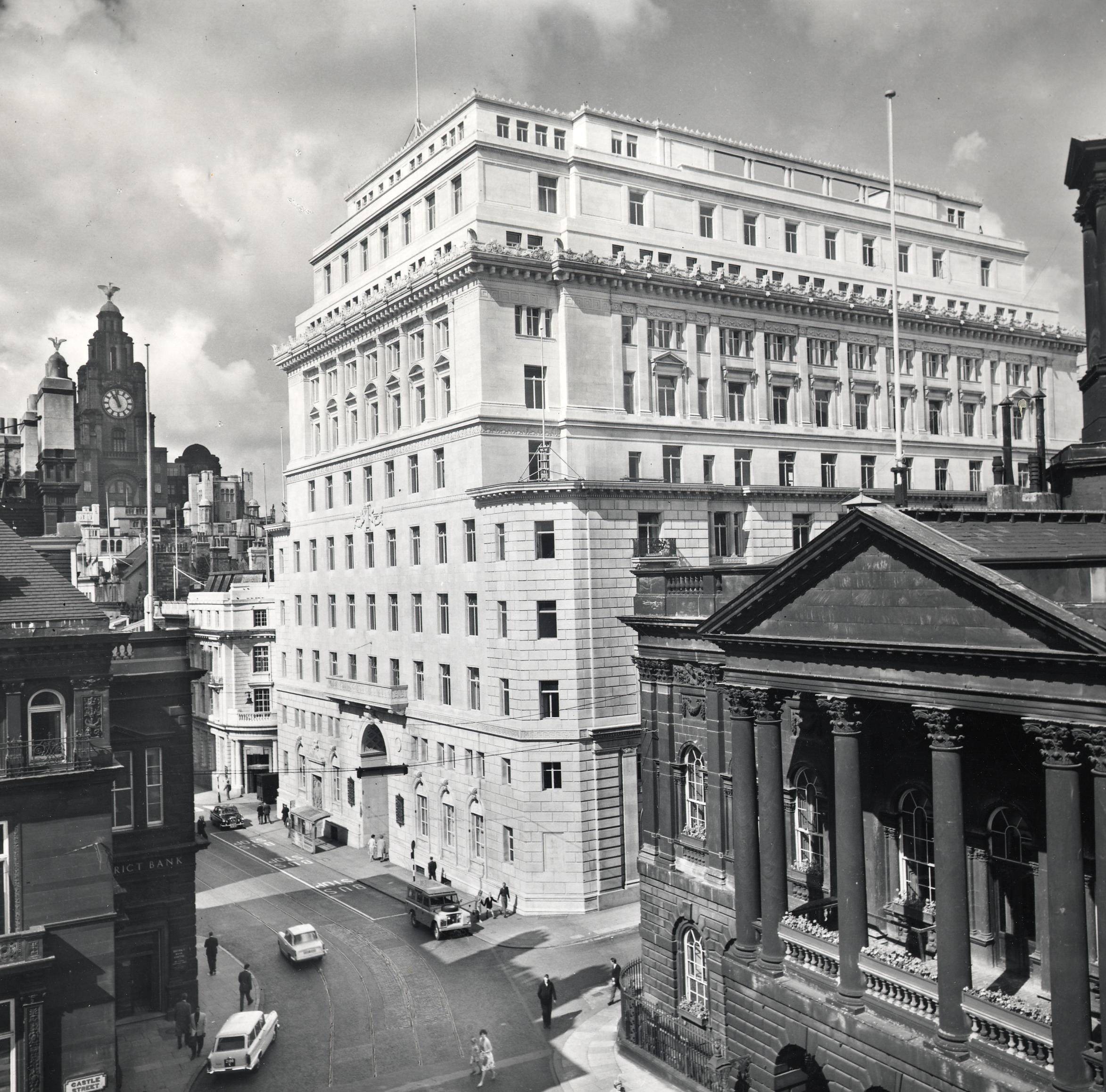
Its national Head Office was the monumental building at 4 Water Street, completed in 1932 to designs by Liverpool architect Herbert J. Rowse.
By the 1950s the volume of routine banking work was growing rapidly. Martins' own contemporary account said postings to customers' accounts had increased by about 160 per cent since 1932. Simply adding more clerical staff was not regarded as a sustainable answer.
The emerging electronic computer offered another possibility. [1]
THE EXPERIMENT BEGINS
Martins had begun seriously investigating electronic data processing during the 1950s. In 1958 the bank produced a detailed computer specification and invited manufacturers to show how their machines could cope with banking work.
The British manufacturer Ferranti emerged as the preferred partner, and Martins staff worked with Ferranti specialists to develop programs around the Pegasus computer.
In 1959 the bank selected its South Audley Street branch in London for a trial. Each day's current-account work was processed conventionally and then processed again electronically so the results could be compared.
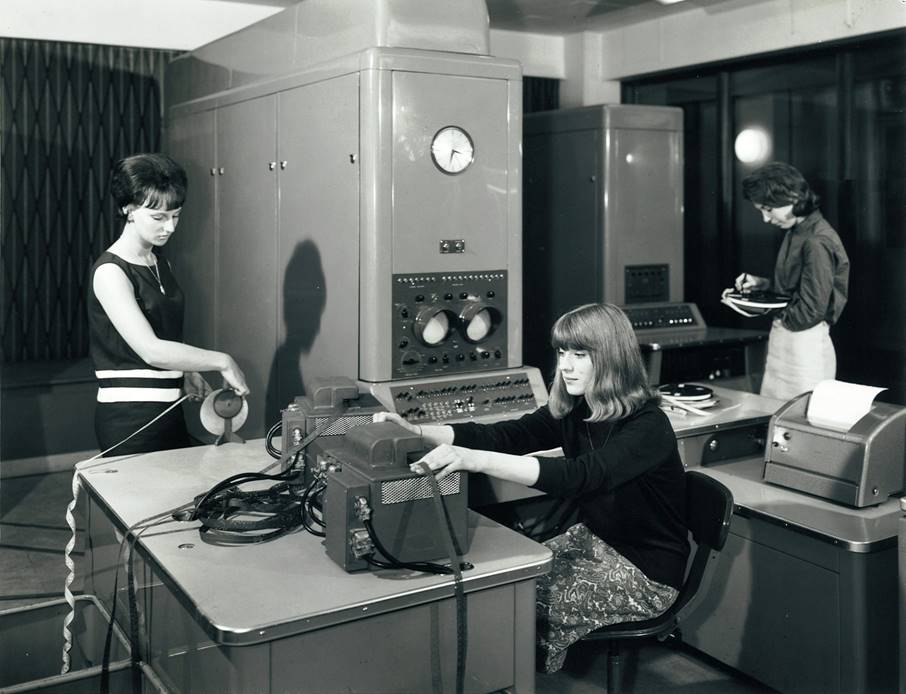
Information from cheques and other transactions was converted into punched paper tape and fed into the computer.
By January 1960 Martins said that, for the first time in Britain, the current-account work of a branch was being operated day by day on an electronic computer. [1]
The bank described itself as the first bank in Britain to use an electronic computer for the complete current-account bookkeeping operation, including producing customer statements.
That wording matters. Martins was not simply the first British bank ever to own or install a computer. Its documented claim concerned the complete everyday bookkeeping of branch current accounts.
PEGASUS COMES TO LIVERPOOL
The London experiment convinced Martins that the idea could work, and the next stage brought the project home to Liverpool.
The bank ordered a Ferranti Pegasus II, an improved version equipped for the large quantities of data required by commercial organisations.
There is a small but important dating wrinkle in the surviving record.
The modern Martins Bank Archive summary says a Pegasus II was installed in Liverpool in 1962. Yet contemporary Martins material reproduced by the archive describes the computer as already installed at Derby House in 1961. Academic research by historian Ian Martin places the opening of Martins' Liverpool Computer Centre on 18 August 1961, after delivery had been delayed by industrial action at a Ferranti subcontractor. [1][4]
For that reason, the safest description is that Martins' Liverpool computer operation was established during 1961–62, with the computer centre operating in 1961 even though some later summaries use 1962.
The machine did not sit in the grand banking hall on Water Street. Martins created a dedicated Liverpool Computer Centre in the basement of Derby House, the former Commercial Reference Library close to the Head Office.
WHAT COULD PEGASUS II ACTUALLY DO?
By modern standards its abilities sound tiny. By the standards of the early 1960s they were extraordinary.
Martins said Pegasus II could deal with approximately 30,000 accounts in five hours with no more than five people in attendance. [1]
The system could post debit and credit entries, add new accounts, remove closed ones, update balances, check transactions against stopped cheques, identify accounts exceeding agreed overdraft limits, accumulate information for charges and management statistics, and produce customer statements.
Customer information and transaction histories were held on magnetic tape and updated electronically. It was an early ancestor of the computerised account databases that modern banking now takes for granted.
FROM A LIVERPOOL BRANCH TO THE COMPUTER CENTRE
The process was still a long way from today's instant banking. There was no permanent online connection linking each branch to Derby House.
At branches involved in the scheme, transactions were entered onto machinery that produced punched paper tape. Martins used ADDO-X machines for data preparation, while the computer centre also maintained Friden Flexowriters for printed output and statements. [2]
Martins explored transmitting data through telephone and telegraph circuits, anticipating the idea of branches communicating directly with a central computer.
Initially, though, branches close to Water Street could use a simpler communications system: the data could be physically carried through Liverpool's streets to Derby House.
It is a wonderful snapshot of a world halfway between two eras — electronic banking inside the building, a porter carrying the data outside it.
FIVE LIVERPOOL BRANCHES BECOME COMPUTER PIONEERS
The new system was not merely a laboratory demonstration.
Heywoods branch was selected to have its daily work processed by Pegasus. Contemporary plans then named Castle Street, Church Street, Victoria Street and Liverpool City Office for transfer during 1961. [1]
The Martins archive later records Castle Street as one of five Liverpool branches whose daily work went onto Pegasus II. [2]
Early automation came with very human problems. Former Martins staff recalled repeated account numbers creating what Ferranti called a “finger pattern”: operators could become so accustomed to typing one frequently used account number that a transaction might be punched against the wrong account.
One recollection tells of a huge shipbuilding payment apparently landing on the wrong customer's account, producing a spectacular accidental overdraft.
The computer was fast. It was not capable of correcting inaccurate information supplied to it.
THE PEOPLE BEHIND THE MACHINE
A computer did not simply arrive and begin running the bank. People had to translate banking procedures into detailed instructions the machine could execute.
One of the central figures was Ron Hindle, Martins Bank's Manager of Organisation, Research and Development, who helped drive the automation programme and worked with Ferranti specialists and Martins programmers.
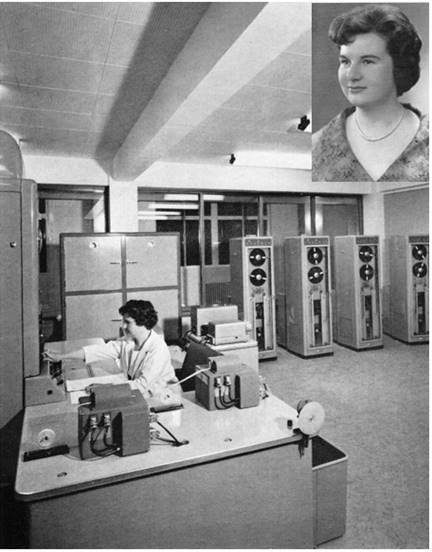
Another important figure was Liverpool-born Edna Devaynes, appointed to supervise the Derby House computer centre. A 1961 Martins Bank Magazine profile described her as supervising the Pegasus II “recently installed” in the basement at Derby House. [3]
Martins was therefore doing more than buying machinery. It was developing its own expertise in systems analysis and programming.
A GLIMPSE OF BANKING'S FUTURE
Martins' ambitions went much further than a handful of Liverpool branches.
The bank considered a future in which branches could communicate with computer centres over telephone lines. Other possible applications included travellers' cheques, overseas operations, statistics and additional accounting functions.
Pegasus II would not ultimately become the machine that computerised the entire Martins network. Technology was advancing rapidly and newer systems offered far greater capacity.
Martins later established a major London computer operation where its Branch Accounting system was developed. The Martins Bank Archive says elements of that work continued to be used after the merger with Barclays. [3]
THEN MARTINS DISAPPEARED
In 1969 Martins Bank became part of Barclays.
The Martins name gradually vanished from Britain's high streets, while computers became smaller, faster and vastly more powerful.
What once required dedicated machine rooms and specialist teams eventually became something millions of people now carry in their pockets.
THE OLD BANK AND THE NEW WORLD
That is what makes the Martins Bank story so fascinating.
Water Street represents two eras at once. The Head Office was designed to communicate solidity, wealth and permanence. Barely three decades after it opened, the organisation behind that façade was embracing technology that would eventually transform almost everything about how banks operated.
Ledgers became electronic records. Paper instructions became data. Branches became connected to central systems. Statements became computer generated.
The magnificent Martins Bank building remains one of Liverpool's great architectural landmarks, but its story is not only about architecture.
Nearby at Derby House, a room full of cabinets, tape drives, paper tape and specialist operators helped demonstrate what the future of banking could look like.
Long before mobile apps, online accounts and contactless payments, Liverpool was already helping Britain learn how to bank by computer.
Citations
Sources & research notes
- [1] Martins Bank Archive — Pegasus II: contemporary Martins Bank Magazine material on the South Audley Street experiment, the bank's “first” claim, Pegasus II's capacity, punched paper tape and the Liverpool rollout. Martins Bank Archive.
- [2] Martins Bank Archive — Liverpool Computer Centre / Castle Street: Derby House, Heywoods branch, data preparation and Castle Street's place among the five Liverpool branches. Liverpool Computer Centre; Castle Street.
- [3] Martins Bank Archive — Branch Accounting: the later development of Martins' computerised branch-accounting system and its legacy after the Barclays merger. Branch Accounting.
- [4] Ian Martin — banking and computer centres: academic research dates Martins' Liverpool Computer Centre opening to 18 August 1961 and discusses the delivery delay and Derby House. Research paper.
- Head Office: background on the Water Street headquarters, which opened for business in 1932. Martins Bank Archive.
- Ferranti Pegasus: wider technical history of the Pegasus family. Computer Conservation Society.
Continue exploring
More Liverpool stories connected to this one
 Another story of technology reshaping LiverpoolLiverpool Lime Street — Before the StationArticle No. 7 · Transport & Railways · 8 min read
 Liverpool's commercial life before computers, cards or modern bankingWhere Liverpool Shopped in 1808Article No. 13 · Culture & Everyday Life · 7 min read
 Another Liverpool business whose reach extended far beyond the cityWhy Titanic Said LiverpoolArticle No. 11 · Maritime & Docks · 7 min read
Continue the conversation
Share this Liverpool story
Follow Out in Liverpool or bring your own memories and knowledge to the Community Group.