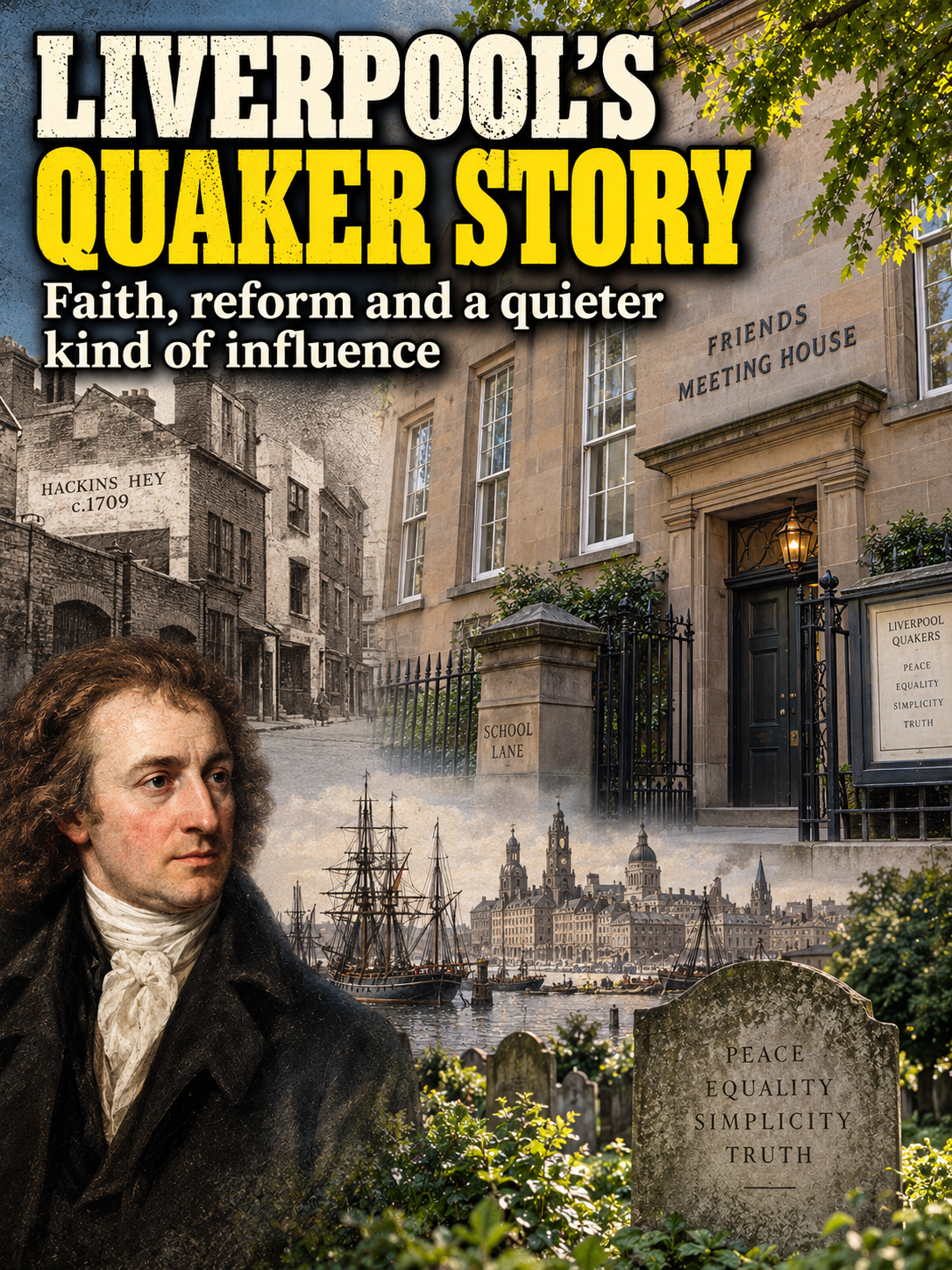
Liverpool’s Quaker story is more than 370 years old. It begins with radical preachers and private meetings in the seventeenth century, passes through Hackins Hey and Hunter Street, becomes entangled with the wealth and moral contradictions of an Atlantic port, and continues today at School Lane.
The Religious Society of Friends — better known as the Quakers — has never been one of Liverpool’s largest religious communities. Yet its influence reaches far beyond numbers. Liverpool Friends and Quaker-linked families became involved in abolition, public health, nursing, education, political reform, peace and social action.
It is also a story that resists easy hero-making. Quakers lived and traded inside a city profoundly shaped by slavery and empire. The Rathbones themselves combined reforming traditions with commercial interests in commodities such as cotton. To understand their place in Liverpool properly, both the reform and the contradiction have to remain visible.
THE FIRST FRIENDS IN LIVERPOOL
The Quaker movement emerged amid the religious upheaval of seventeenth-century England. Its followers rejected a professional priesthood and elaborate worship, emphasising direct spiritual experience and equality.
Liverpool entered that story very early. The Quaker Meeting Houses Heritage Project records that in 1652, two of George Fox’s “Publishers of Truth”, Richard Hubberthorne and John Lawson, preached in Liverpool.
A Meeting was established at Knowsley in 1657. Friends in Liverpool initially met in one another’s homes and were regarded as part of the Knowsley Meeting. This was a period when nonconformity could carry serious consequences and Quakers were frequently subjected to fines, imprisonment and legal restrictions.
As Liverpool grew, the centre of the local Quaker community shifted towards the town. In 1709, Liverpool Friends acquired their first meeting house in Hackins Hey, a narrow passage in the old commercial town close to Dale Street. In 1710 the Hardshaw Monthly Meeting formally renamed the Knowsley Meeting as the Liverpool Meeting.
The distinction between those dates is useful: 1709 marks the acquisition of the Hackins Hey meeting house; 1710 marks the formal change to the Liverpool Meeting name.
HACKINS HEY — A MEETING HOUSE IN THE GROWING PORT
Hackins Hey was not a rural retreat. It was part of the tightly packed street pattern of old Liverpool, close to the commercial heart of a town that was about to change dramatically.
When Friends acquired the building in 1709, Liverpool’s Old Dock had not yet opened. The enclosed wet dock followed in 1715. Over the decades that followed, Liverpool expanded into a major Atlantic trading centre.
By the late eighteenth century, the Hackins Hey premises were too small. In 1788, Friends purchased a site on Hunter Street for a new purpose-built meeting house. It opened in 1791 and became the principal home of Liverpool Quakers for roughly the next century and a half.
WILLIAM RATHBONE IV — ABOLITIONIST AND DISSENTER
No family is more closely associated with Liverpool’s Quaker inheritance than the Rathbones.
William Rathbone II moved to the growing port in the eighteenth century and established a timber business. The family subsequently developed extensive mercantile interests and became one of Liverpool’s best-known civic dynasties.
William Rathbone IV (1757–1809) occupies a particularly important place in the story. University of Liverpool Special Collections describes him as a committed abolitionist from an early age and a founder member of the Liverpool Committee for the Abolition of the Slave Trade.
That position was significant because Liverpool had become Britain’s dominant slave-trading port. The city’s merchants, ships, insurers, suppliers and investors were deeply involved in the transatlantic system that transported enslaved Africans to the Americas.
Liverpool’s principal role was not as a port where vast cargoes of enslaved people were routinely landed and auctioned. Its importance lay above all in financing, fitting out and dispatching slave ships and in the commercial networks surrounding the trade. Individual enslaved people were present in Britain and some sales in Liverpool are documented, but that should not be confused with the mass plantation-market system on the other side of the Atlantic.
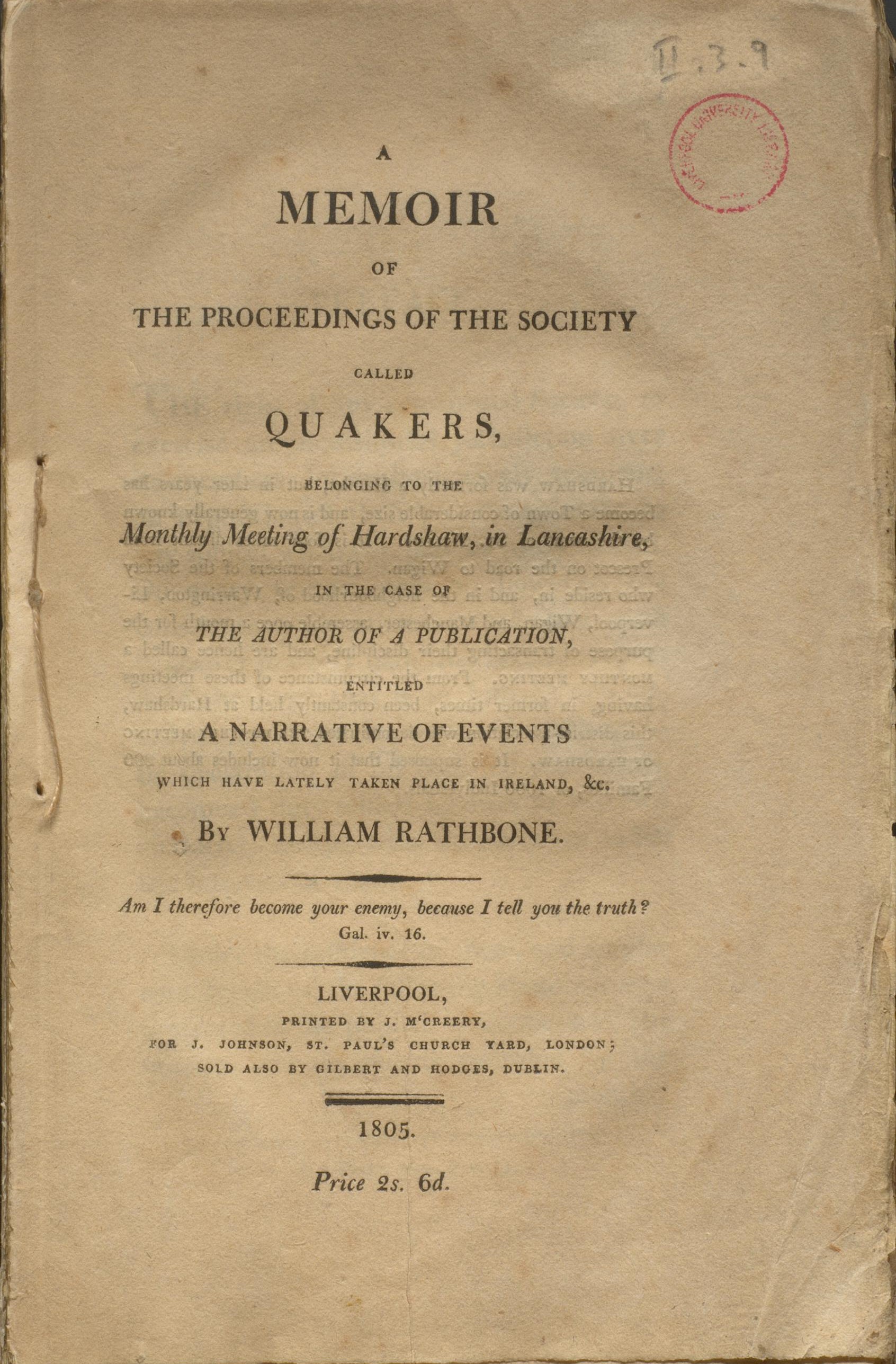
Rathbone’s relationship with Quakerism itself became strained. His criticism of what he regarded as intolerance within the Society culminated in publications about disputes among Friends in Ireland. In 1805 he was disowned by the Society of Friends. The book reproduced above belongs directly to that episode.
THE RATHBONE CONTRADICTION
It is tempting to turn the Rathbones into uncomplicated symbols of Liverpool’s conscience. The historical record is more demanding.
The family’s later merchanting business dealt in commodities including American cotton, China tea and Brazilian coffee. In the nineteenth century, much American cotton was produced by enslaved labour. Opposition to the transatlantic slave trade did not automatically remove merchants from economic systems connected to slavery.
The Rathbone story therefore illustrates both reform and entanglement: people could oppose one form of slavery-related commerce while remaining economically connected to another.
FROM ABOLITION TO PUBLIC HEALTH
Later generations of the family carried the reforming tradition into different fields.
William Rathbone VI (1819–1902) became closely associated with the development of district nursing. After seeing the value of skilled nursing during the final illness of his first wife, Lucretia, he sought ways to make comparable care available to poorer families in their own homes.
Working with Florence Nightingale and others, Rathbone helped establish the Liverpool Training School and Home for Nurses in 1862. From that base, a district nursing system developed across Liverpool during the 1860s and later influenced nursing provision elsewhere.
He was also involved in workhouse nursing reform and higher education. University of Liverpool records show that he was closely involved in the formation of University College, Liverpool in 1882, helped found a Professorship in English with his brothers, and later served as president of the college.
HUNTER STREET, WAR AND A CHANGING CITY
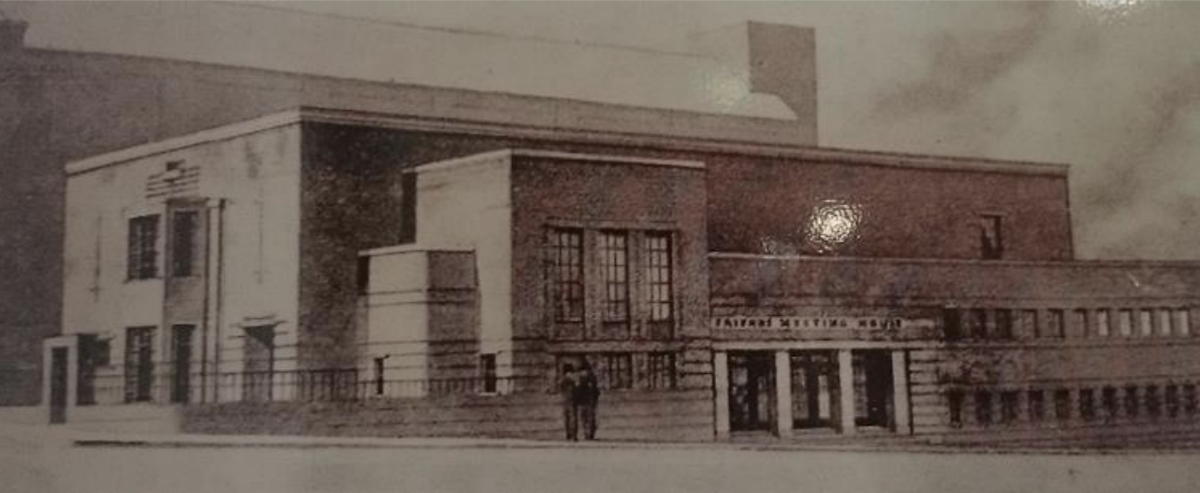
The Hunter Street meeting house opened in 1791 and remained the centre of Liverpool Quaker life for generations.
Its long history ended violently during the Second World War. The Quaker Meeting Houses Heritage Project records that the building was destroyed by bombing on 4 May 1941, during the Liverpool Blitz.
The present Quaker Meeting House on School Lane dates from 2006. Designed by Page and Park, it stands beside the Bluecoat in the heart of Liverpool ONE — a modern building carrying a community whose local history reaches back to the seventeenth century.
ARUNDEL AVENUE — THE HIDDEN BURIAL GROUND
Another part of the Quaker story survives away from the city centre.
The detached burial ground at Arundel Avenue occupies land purchased in 1856 on what was then Smithdown Lane. Early Quaker burials were characteristically unmarked; headstones were permitted later, but the visual language remained restrained compared with the elaborate memorial culture of many Victorian cemeteries.
The last burial there took place in 1961.
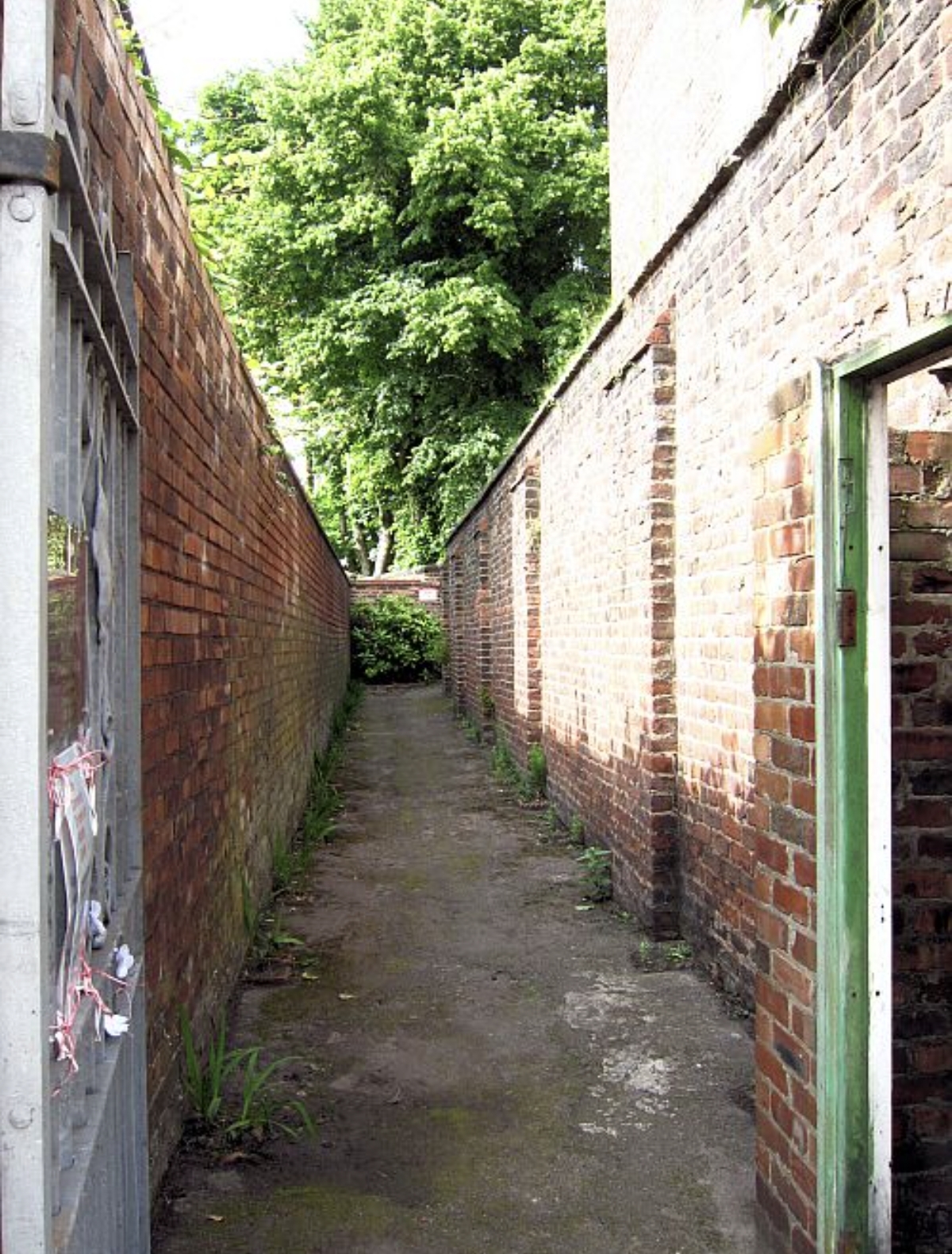
Today the site is remarkable partly because of how hidden it is. A narrow entrance from Arundel Avenue opens into a much larger green space behind the surrounding houses. Community work has helped develop the old burial ground as an orchard, wildlife garden and quiet neighbourhood space while retaining its historic character.
A LIVING MEETING ON SCHOOL LANE
Liverpool’s Quaker history did not end with the Rathbones, the Blitz or the burial ground.
The Religious Society of Friends continues to meet at 22 School Lane. Liverpool Quakers currently hold their main Meeting for Worship on Sunday at 10.30am, with shorter meetings on Tuesday at 6pm and Thursday at 1pm. A Children’s Meeting also runs on Sundays.
Quaker worship remains notably different from conventional church services. There is no appointed minister leading a set liturgy. Worship begins in silence, with spoken ministry arising only if someone feels moved to contribute.
The School Lane building is also used throughout the week for meetings, activities and community events. Liverpool Quakers describe current social-action interests including peacebuilding, refugee support, the Living Wage and environmental sustainability.
This is therefore not simply the history of a vanished denomination represented by an old building or archive. It is a living religious community occupying a modern meeting house in the centre of Liverpool.
MORE THAN THE RATHBONES
The prominence of the Rathbone name can easily overwhelm the wider story.
Liverpool Quaker history encompasses hundreds of less-famous Friends: people who gathered in houses before there was a permanent meeting house; worshippers who used Hackins Hey and Hunter Street; families buried at Arundel Avenue; campaigners, teachers, businesspeople and peace activists whose names rarely appear in conventional histories of the city.
Nor should every reform associated with a Rathbone automatically be described as “Quaker”. Religious affiliations changed across generations, and some members of the family moved towards Unitarianism or other positions. The more accurate conclusion is that Quaker traditions formed an important strand within a much wider family culture of dissent, public service and reform.
A QUIET THREAD THROUGH LIVERPOOL
Liverpool’s history is often told through things designed to be noticed: enormous docks, monumental civic buildings, ocean liners, football grounds and music that travelled around the world.
The Quaker story works differently.
Its landmarks include a meeting house tucked into Hackins Hey, a religious community prepared to challenge itself, an abolitionist campaigning in Britain’s greatest slave-trading port, nurses travelling into working-class homes, a burial ground hidden behind houses and a modern meeting house beside the Bluecoat.
There is no need to turn that history into a story of saints. The contradictions are part of it. Liverpool Quakers and Quaker-linked merchants lived inside the same commercial world as everyone else. The Rathbones’ history includes both abolitionism and trade in commodities connected to enslaved labour. William Rathbone IV could be a committed Quaker and then be expelled by the Society he criticised.
From 1652 to School Lane today, Liverpool’s Quaker history shows people repeatedly asking what belief should mean in practice — in commerce, slavery, health, education, peace and community life.
More than 370 years after the first Quaker preachers arrived, the Meeting continues.
The history is quiet. Its footprint on Liverpool is not.
Citations
SOURCES & FURTHER READING
- Quaker Meeting Houses Heritage Project — Liverpool Local Meeting. Survey covering the 1652 preaching, Knowsley Meeting, Hackins Hey, Hunter Street, the 1941 destruction, Arundel Avenue and School Lane. Read the heritage report.
- University of Liverpool Special Collections & Archives — Rathbone Papers. Family business, political, religious and reform records. Explore the Rathbone Papers.
- University of Liverpool — “Revealing the Rathbones: William IV and Hannah Mary”. William Rathbone IV’s abolitionism, Quaker dispute and Greenbank life. Read the archive feature.
- University of Liverpool Special Collections — William Rathbone VI. District nursing, workhouse reform and University College Liverpool. Read the guide.
- Liverpool Quakers. Current worship, community activities and faith in action. Liverpool Quakers.
- That’s How The Light Gets In, 2014. Account and photographs of Arundel Avenue burial ground’s community-garden opening. Read the account.
Continue the conversation
Share this Liverpool story
Follow Out in Liverpool or bring your own memories and knowledge to the Community Group.