
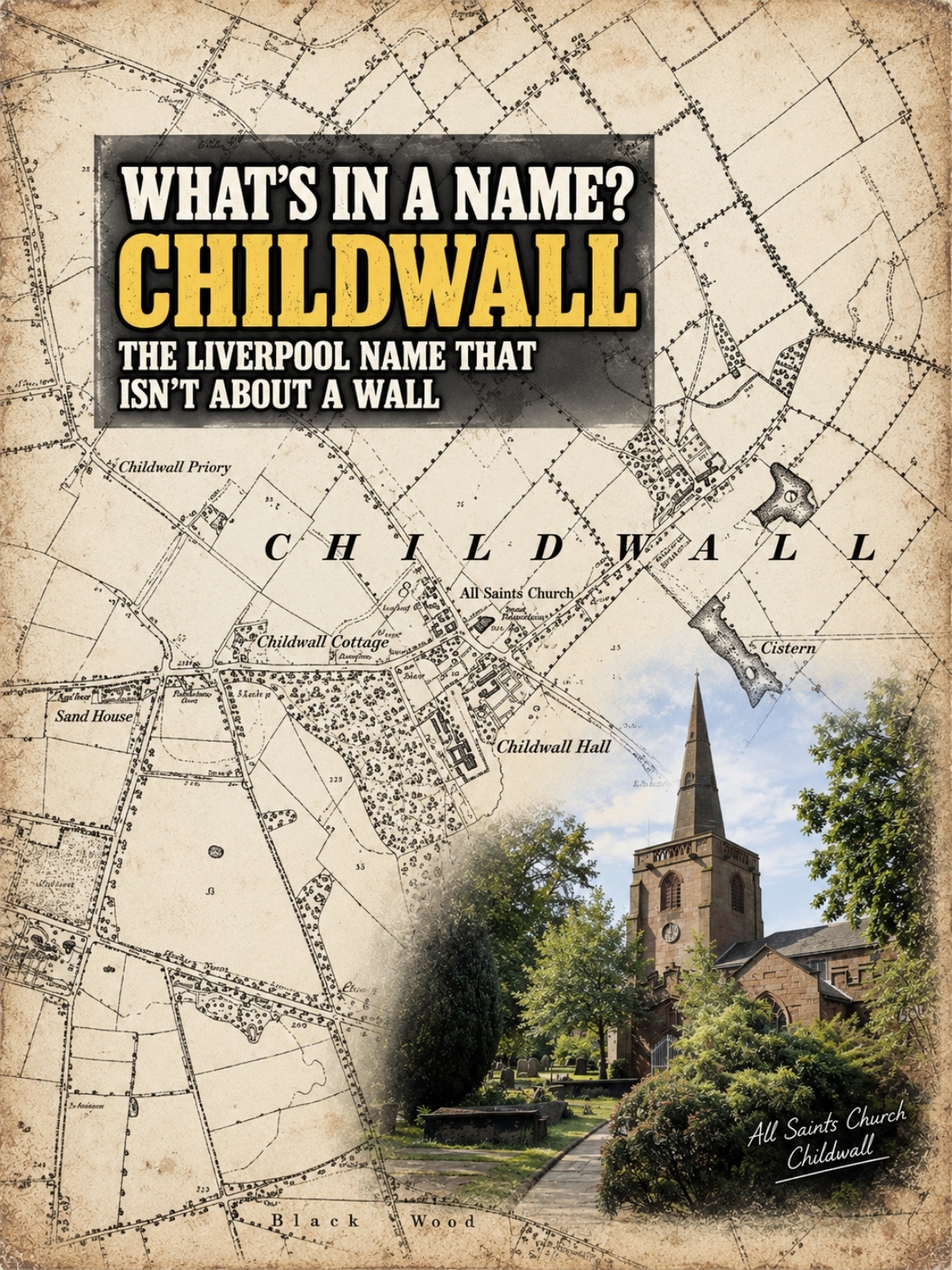
Childwall looks like one of Liverpool’s easiest place names to explain. A child. A wall. Simple. Except the name almost certainly has nothing to do with a wall at all.
Childwall is one of the oldest recorded settlements in what is now Liverpool. It appears in the Domesday Book of 1086 as Cildeuuelle. That early spelling contains the clue to the name’s real meaning: the ending that eventually became modern “wall” almost certainly comes from an Old English word connected not with masonry or fortifications, but with water. [1][2]
THE CLUE HIDDEN IN THE OLD NAME
Place-name scholar Eilert Ekwall, whose 1922 The Place-Names of Lancashire remains one of the key studies of Lancashire names, recorded a succession of early Childwall forms including Cildeuuelle, Childewell, Childewalle and Childewall. Medieval spelling was never fixed, and the same place could be written differently by different clerks over several centuries. [2]
Ekwall identified the second element as Old English wælla, meaning a well, spring or brook. That makes the modern spelling deceptive. There is no need to imagine a lost defensive wall giving Childwall its name; the oldest forms point towards water. [2]
BUT WHAT DOES THE “CHILD” MEAN?
The first half of the name is less certain. Ekwall favoured an Old English interpretation connected with children, suggesting something close to “the children’s well” or “the children’s brook.” A later Liverpool historic settlement study allows another possibility, interpreting the name as “the stream of the children or of Cilda”, with Cilda potentially being a personal name. [2][3]
That distinction matters. The water element is the strongest part of the explanation; exactly who or what the first element referred to is harder to recover after more than nine centuries.
OTHER SCHOLARS HAD OTHER IDEAS
Childwall has attracted competing interpretations. In the late nineteenth century, Henry Harrison proposed an Old Norse origin, linking a word for a spring or well with one for a field, producing a meaning roughly equivalent to “Wellfield” or “Springfield.” It was an understandable suggestion in a region with considerable Scandinavian place-name influence, but later scholarship did not favour it. [4]
Henry Cecil Wyld proposed another explanation involving an unusual Old English water term. Ekwall considered that theory unconvincing and instead preferred the Old English wælla explanation. Both ideas belong in the history of Childwall scholarship, but neither carries the same weight as Ekwall’s interpretation. [2][5]
A LANDSCAPE OF WELLS AND STREAMS
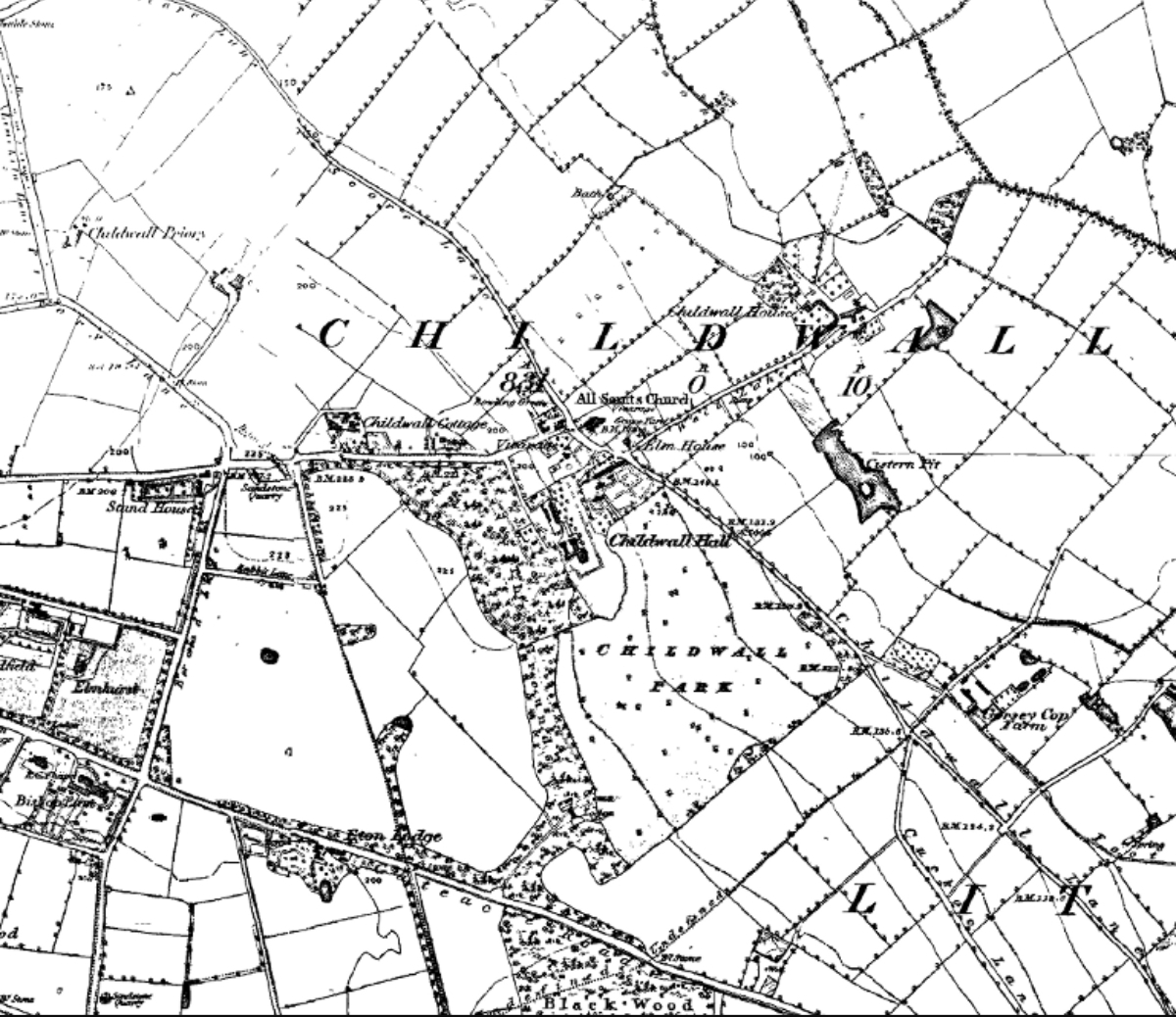
Historic Childwall makes that interpretation easier to understand. The old settlement occupied rising ground, and water features were part of the surrounding landscape. Childwall Brook, Well Lane and the medieval holy well traditionally known as Monk’s Bath all preserve that connection. [3][6]
They do not, however, prove that any one surviving feature was the well or stream that originally gave Childwall its name. They tell us something broader and more useful: this was a landscape in which springs and flowing water mattered enough to leave their mark on local names.
Childwall’s appearance in Domesday adds another layer to the story. A priest was recorded there in 1086, showing that an established religious presence already existed in the settlement. [1]
ALL SAINTS AND THE OLD VILLAGE
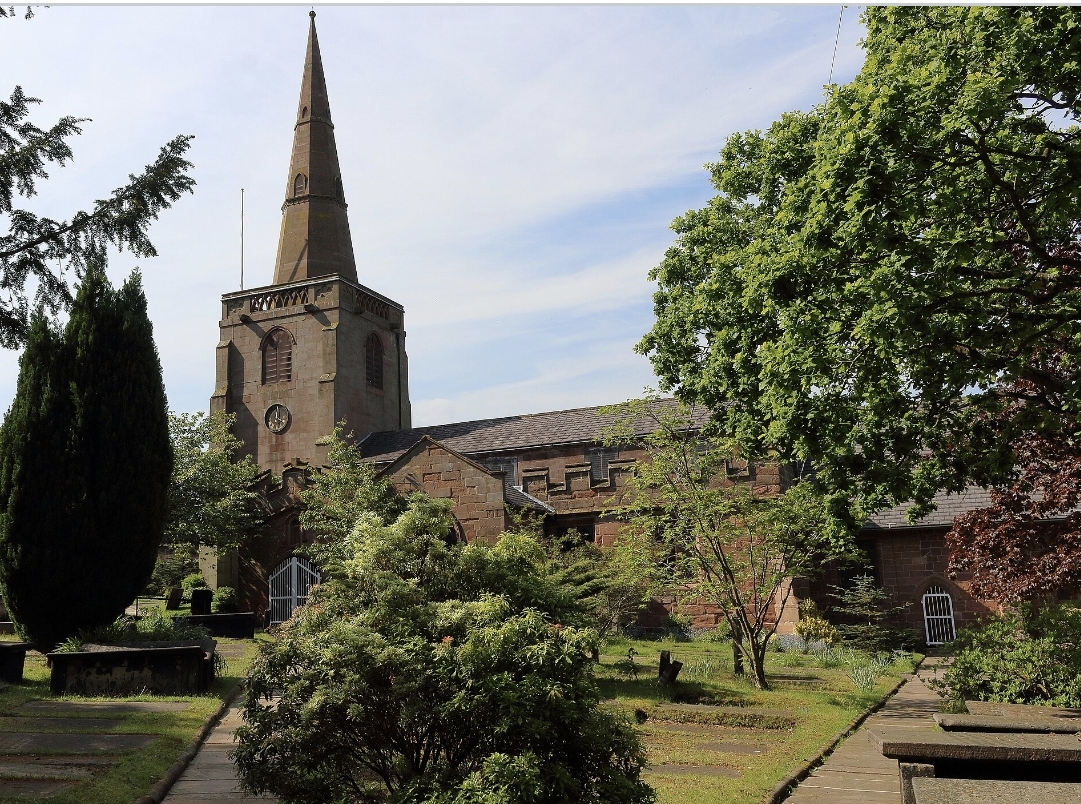
The strongest surviving physical connection with historic Childwall is All Saints’ Church. Historic England describes it as Liverpool’s only surviving medieval church. Parts of the present building date from the fourteenth century, with later rebuilding and additions reflecting centuries of change. [7]
The Domesday reference to a priest tells us that a religious presence existed at Childwall long before the oldest surviving fabric of the present church. What it does not prove is that the building standing today is the church that existed in 1086. All Saints gives us remarkable continuity with the old settlement, but its story spans several different periods rather than one uninterrupted medieval structure. [1][7]
AND WHAT ABOUT CHILDWALL ABBEY?
Another familiar local name can be misleading. Childwall Abbey Road and the Childwall Abbey Hotel make it easy to imagine that a medieval abbey once stood here.
It did not. The “Abbey” name is associated with Childwall Hall, a later Gothic house whose romantic appearance helped create the description. Liverpool’s historic settlement study specifically cautions against treating the name as evidence of an actual abbey. [3]
There were genuine medieval religious connections in Childwall. A medieval abbey was not one of them.
SO WHAT DID CHILDWALL MEAN?
We cannot translate the name with complete certainty, but the evidence can be ranked fairly clearly. The strongest linguistic evidence points to Old English wælla — a well, spring or brook. Ekwall favoured a first element connected with children, while a personal name such as Cilda remains possible. Harrison’s Norse “Wellfield” explanation is historically interesting but less favoured by later scholarship, and Wyld’s alternative water theory was not accepted by Ekwall. [2][3][4][5]
The safest interpretation is therefore something close to “the children’s well or stream”, while acknowledging that the precise meaning of the first part may never be recoverable.
What we can say much more confidently is what Childwall does not mean. It was never simply child + wall.
Today Childwall is surrounded by roads, houses and modern suburbia, but beneath all that survives a name already being written down more than 900 years ago. It takes us back to a settlement beside springs and streams, to a priest recorded in Domesday, and to a landscape whose water left its mark on the place itself.
The spelling changed. The village changed. Liverpool grew around it.
But Childwall is still a name written in water.
Citations
SOURCES & FURTHER READING
- Open Domesday — Childwall. Domesday entry for Childwall, including the 1086 form and the recorded priest. Open Domesday.
- Eilert Ekwall — The Place-Names of Lancashire (1922). Early forms of Childwall and the Old English wælla interpretation. Wikimedia Commons scan.
- Liverpool Historic Settlement Study — Childwall. Historic settlement, place-name interpretation, water features and the later “Abbey” tradition. Museum of Liverpool PDF.
- Henry Harrison — The Place-Names of the Liverpool District (1898). The earlier Old Norse interpretation of Childwall. Wikimedia Commons scan.
- Henry Cecil Wyld — The Place Names of Lancashire, Their Origin and History. An alternative explanation of the first element discussed in later scholarship. Digitised scan.
- Historic Liverpool — Childwall township. The 1849–50 Ordnance Survey map and discussion of the historic village landscape. Historic Liverpool.
- Historic England — Church of All Saints. Grade I listing and surviving medieval fabric, including the fourteenth-century chancel. Historic England.
- Wikimedia Commons — All Saints, Childwall from the south. Photograph by Phil Nash, licensed CC BY-SA 4.0. Wikimedia Commons.
Continue the conversation
Share this Liverpool story
Follow Out in Liverpool or bring your own memories, maps and local knowledge to the Community Group.