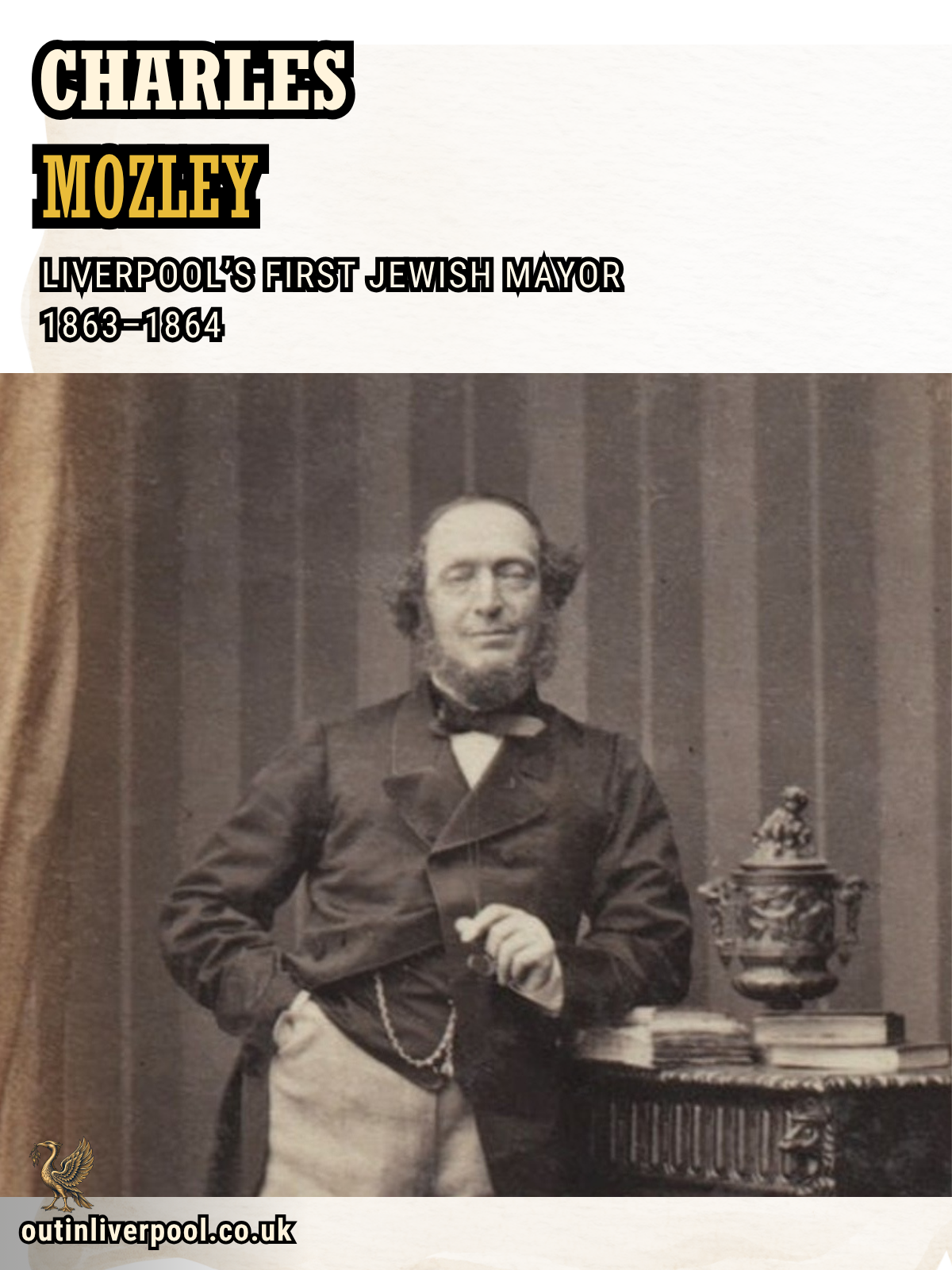
Liverpool elected its first Jewish mayor in 1863. Charles Mozley had already spent years in banking, communal leadership and local politics. Yet when he reached the mayoral chair, his religion became the subject of an attack from a Liverpool pulpit. The law allowed him to hold office; his acceptance as Liverpool’s representative could still be challenged. [1, 2, 6, 8]
His term, 1863–64, fell between those of Richard Cardwell Gardner and Edward Lawrence. He served as Mayor of Liverpool, before the later title of Lord Mayor. His public life brought together institutions that could welcome his support and people who objected to his religion. [1, 8]
From Seel Street to the council chamber
Born in 1797, Mozley belonged to a family established within Liverpool’s Jewish community. His parents were Sarah Joseph and Morris Lewin Mozley; his sister Amelia married Israel Barned. The Joseph, Mozley and Barned families appear throughout the history of the community’s institutions and burial grounds. [3, 12]
Barned’s business helps explain the commercial setting. Saul Marks’s study of Deane Road Cemetery describes the private bank formed around 1830 by Barned and the three Mozley brothers, lending to shipping, cotton and timber firms. Banking connected the family to the businesses of the port. [24]
The overlap between business and communal work was practical. Most of the Deane Road burial-ground committee’s early meetings took place at Barned & Co.’s premises on Lord Street. Barned chaired the committee and Charles’s brother Elias acted as its honorary secretary. Their individual roles belonged within a network of family, finance and community responsibilities. [24]
The Old Hebrew Congregation worshipped at Seel Street, where a synagogue had been erected in 1807–08 on land given by the municipality. Jewish communal life therefore had a long relationship with Liverpool’s civic authorities before Charles became mayor. [8]
Mozley served as the congregation’s junior warden in 1845–46 and senior warden in 1852–53 and 1853–54. The senior warden chaired the committee supervising the congregation’s everyday affairs. These posts involved the administration of a community as well as religious observance. [4, 24]
Education occupied another substantial part of his public life. Joe Wolfman’s biography describes his speech at the laying of the Hebrew schools’ new building’s foundation stone in 1852. Research based on Cyril P. Hershon’s study records his presidency of the schools from 1854 to 1866 and credits him with helping clear their debt and secure the freehold in 1862. That achievement preceded his mayoralty. [5, 18]
The schools sought to provide Jewish education while preparing children for life in England. Their managers dealt with premises, subscriptions, staffing and government inspection. Children had a two-hour midday break to eat at home, and a Ladies’ Soup Committee was providing assistance in 1863. Free places existed alongside parental contributions. [18]
Such details bring Mozley’s educational work down to the scale of a school day. Buildings needed financing, teachers needed appointing and children needed feeding. His presidency continued through his year as mayor, linking a longer commitment to education with his municipal career. [18]
He was also a Liberal councillor. Wolfman dates his elections for Rodney Ward to 1857, 1860 and 1863, and his appointment as a magistrate to 1860. By the time he reached the mayoral chair, he had experience of both council politics and communal administration. [5]
The declaration that barred Jewish officeholders
A national legal change had helped make that career possible. Municipal office required a declaration containing the words “on the true faith of a Christian”. A Jewish candidate could secure election and still face a requirement incompatible with his religion. [7]
On 17 July 1845, Sir Robert Peel explained the problem to the Commons. Practice varied between corporations: some Jewish officeholders had served through arrangements involving delayed declarations and indemnity legislation. Their position could depend on how a local authority applied the rules. Peel’s Jewish Disabilities Removal Bill sought to remove that uncertainty. [7]
He pointed to Mr Salomons, who had served as sheriff but was then prevented from taking up office as an alderman because of the declaration. Someone could discharge one demanding public office and still be shut out of another. The debate concerned the conditions for serving, as well as the right to be chosen. [7]
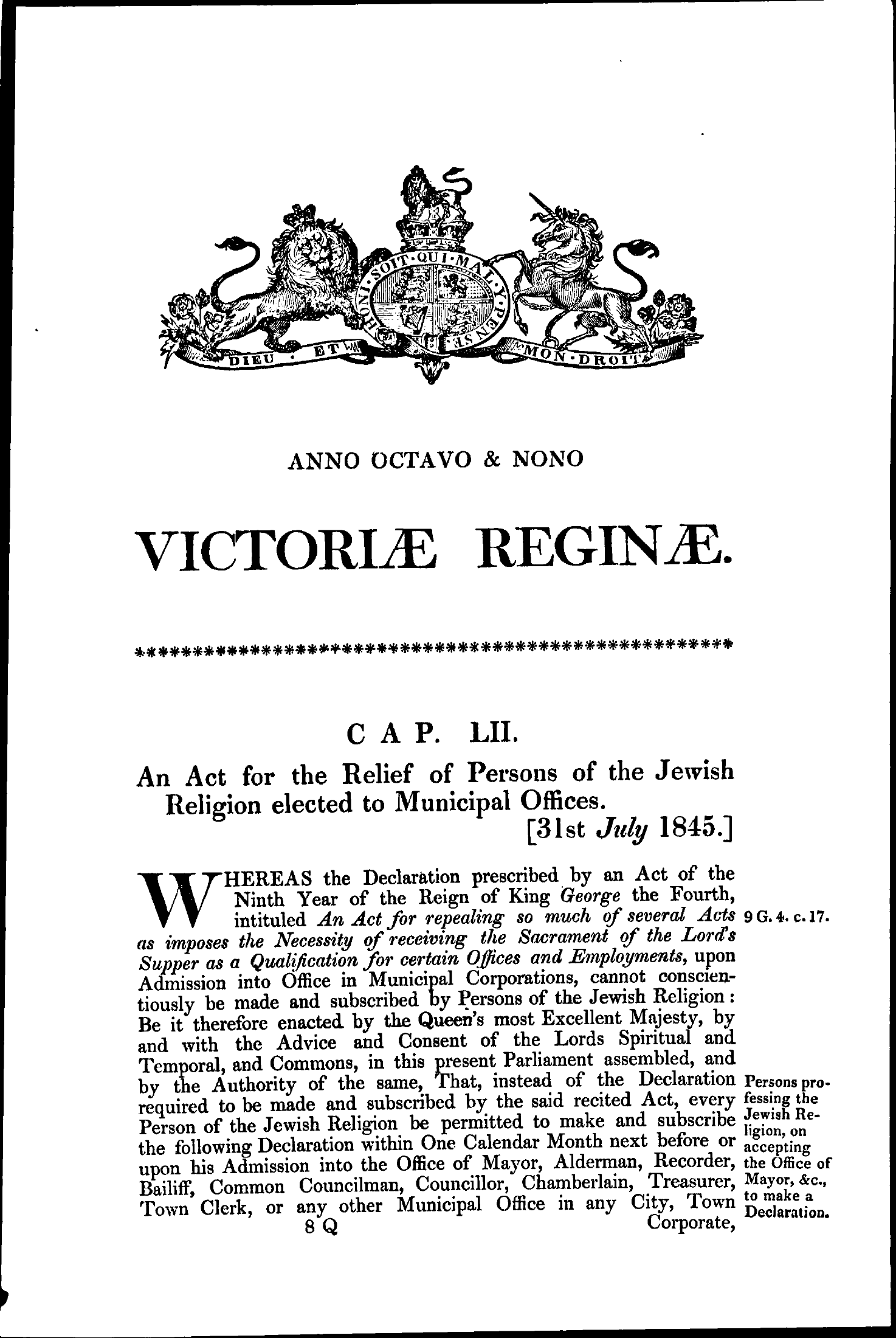
The resulting Act received royal assent on 31 July. It expressly covered mayors, aldermen, councillors and other municipal officers, permitting a person professing Judaism to make an alternative declaration. [6]
The replacement retained a promise not to use the office’s power or influence to injure or weaken the established Protestant Church or disturb its rights and privileges. Parliament was opening municipal office to Jewish citizens while continuing to safeguard the Church’s position. The conditions under which they entered public life still reflected that religious settlement. [6]
Eighteen years separated the legislation from Mozley’s mayoralty. His election shows one consequence of removing the barrier: a Jewish councillor could become the town’s first citizen. The controversy that followed shows how much resistance could remain after the law had changed.
A Jewish mayor and a hostile pulpit
Mozley’s fellow council members chose the mayor. Under the municipal framework established in 1835, the office was elected annually from among the councillors and aldermen. It was distinct from the later directly elected executive and regional mayoralties. The underlying municipal electorate was itself restricted to male ratepayers; religious inclusion advanced within a system that still excluded many residents from political power. [23]
The choice placed Mozley at the head of an institution with Christian associations. At St George’s Church in Derby Square, the Reverend James Kelly preached against the appointment of a Jewish mayor. This was St George’s Church, a different building from the Hall used for Liverpool’s major civic gatherings. [8, 9]
Historian Caroline Shaw traces Kelly’s attacks into the local press. Randall Sherlock’s Liverpool Mail followed his disputes with particular enthusiasm, but its treatment of him employed anti-Irish stereotypes. Hostility towards Kelly’s conduct did not prevent the newspaper from drawing on another form of prejudice. [9]
That makes the controversy more revealing than a straightforward division between tolerant supporters and an intolerant clergyman. The language of public debate carried several kinds of exclusion at once. Mozley’s appointment became an occasion for arguments about religious authority, civic representation and the treatment of minorities.
Kelly sued Sherlock for libel. He won, but the jury awarded him a single farthing in damages. His attempt to obtain a new trial failed. The case concerned the newspaper’s treatment of Kelly; the verdict was not a judgment on Mozley’s entitlement to hold office. [9]
Mozley remained mayor. The dispute demonstrates that reaching the highest civic office did not place a Jewish citizen beyond religious hostility, even when the appointment had been made through Liverpool’s own municipal institutions.
The mayor at the Town Hall
On Tuesday 19 January 1864, Mozley attended a Town Hall ball in aid of the West Lancashire Masonic Educational Institution. The Freemasons’ Magazine and Masonic Mirror, reporting the event on 6 February, named him among both the patrons and those present. [10]
Bands stood on either side of the grand staircase. Quadrille bands played in the ballrooms, while guests wore Masonic regalia, military uniforms and evening dress. More than 600 people attended. The report gives a lively glimpse of the setting in which the mayor appeared before Liverpool society. [10]
The institution supported the education and advancement of children of deceased or distressed Freemasons. According to the report, the ball enabled its committee to hand £135 to the treasurer. The evening’s entertainment helped finance an organisation with a specific charitable purpose. [10]
Thomas Wylie chaired the management committee. Mozley’s documented role was mayor, patron and guest: the report credits the organising work to others. His presence nevertheless forms part of the record of how he represented Liverpool during his term. [10]
Shakespeare for the town
Liverpool’s Shakespeare tercentenary celebrations followed that spring. Writing in 1908, theatre historian R. J. Broadbent credited Mozley with arranging free access to theatres and other places of entertainment for working people, alongside a fancy-dress ball at St George’s Hall. [17]
Broadbent dates the free performances to 22 April 1864. At the Theatre Royal he names Much Ado About Nothing, with Kate Saville as Beatrice. In his account of the Amphitheatre, he describes Hamlet, with Miss Marriott in the title role, and again associates the free admission with Mozley. These particulars remain the account of a later historian. [17]
His description presents working people participating in the celebrations through free entertainment while the Hall hosted its ball. It gives Mozley a more active cultural role than the attendance recorded at the January charity gathering, although it does not establish the detailed payment arrangements.
Other Shakespeare activity that week is documented in a contemporary record. On 20 April, the Historic Society of Lancashire and Cheshire held a meeting with an oration by the Reverend Abraham Hume and an exhibition of early editions and related objects. John Fitchett Marsh chaired it. The meeting shows the wider enthusiasm surrounding the anniversary; its account does not place Mozley among those attending. [19]

The reversal after office
Mozley’s banking career brought a substantial reversal after his mayoralty. Barned’s Banking Company failed in 1866. The Baring Archive catalogue identifies him as chairman and describes correspondence from April to June concerning the failure, the settlement of the bank’s affairs and other failures dependent on Barned’s. [11]
Mozley subsequently left Liverpool for London. His death in 1881 closed a life that had extended from the community’s early nineteenth-century institutions into a period when a Jewish citizen could hold Liverpool’s mayoralty. [3, 12]
The family’s financial history also needs careful separation. Jim Powell’s study of Liverpool’s cotton trade identifies Charles’s son Albert Charles in accounts of later speculation and bankruptcy. Those events should not be transferred to the former mayor simply because they shared a surname. [13]
What his election changed
Mozley’s election established that a Jewish man could stand at the head of Liverpool’s municipal government. The declaration that once obstructed that path had been changed, and the council had exercised its choice. Kelly’s response exposed the distance between admission to office and acceptance by every part of public life.
That is the lasting significance of his mayoral year. Religious emancipation had become visible in the person representing Liverpool, while prejudice continued to challenge who belonged there. His name on the civic roll records a barrier crossed; the controversy around it shows why crossing it mattered.
Evidence & further reading
Sources and references
- Liverpool City Halls, Civic Honours.
- Encyclopaedia Judaica, Liverpool, hosted by Jewish Virtual Library.
- National Portrait Gallery, Charles Mozley, Ax53029.
- Liverpool Old Hebrew Congregation, Annual Report 2021–22.
- Joe Wolfman, Charles Mozley, Deane Road Cemetery.
- An Act for the Relief of Persons of the Jewish Religion elected to Municipal Offices, 1845, 8 & 9 Vict. c.52.
- Hansard, Jewish Disabilities, 17 July 1845.
- University of Liverpool, Abercromby Square exhibition, Panel 8.
- Caroline Shaw, Privilege and Prejudice in 1865 Liverpool, Legal History Blog, 23 September 2019.
- Freemasons’ Magazine and Masonic Mirror, 6 February 1864, printed pp.112–13, PDF pages 16–17.
- Baring Archive, House Correspondence, British Isles, HC3.35, printed p.21.
- Philip Sapiro, Upper Frederick Street burial ground and the leading families of eighteenth-century Liverpool UK Jewry, 2025.
- Jim Powell, Cotton, Liverpool and the American Civil War, PhD thesis, University of Liverpool, October 2018.
- R. J. Broadbent, Annals of the Liverpool Stage, Liverpool: E. Howell, 1908, printed pp.171–72 and 238; full OCR.
- Genesis of a Jewish Day School, based on Cyril P. Hershon’s thesis, in Provincial Jewry in Victorian Britain, hosted by JCR-UK.
- Historic Society of Lancashire and Cheshire, Transactions, session 1863–64, printed p.250 and continuation p.251.
- Alice Baxter, History of local government in English towns and cities, House of Commons Library research briefing CBP-10233, 3 April 2025, printed pp.12–13.
- Saul Marks, Birth of a Cemetery: The Story of Deane Road, 2006, Deane Road Cemetery.
The January 1864 charity-ball report is contemporary evidence. The Shakespeare programme and free performances are attributed to R. J. Broadbent’s 1908 history. The original council proceedings have not been inspected, so this article does not offer a complete assessment of Mozley’s municipal decisions.
Continue the conversation
Share this Liverpool story
Which other Liverpool mayor’s story would you like us to uncover?