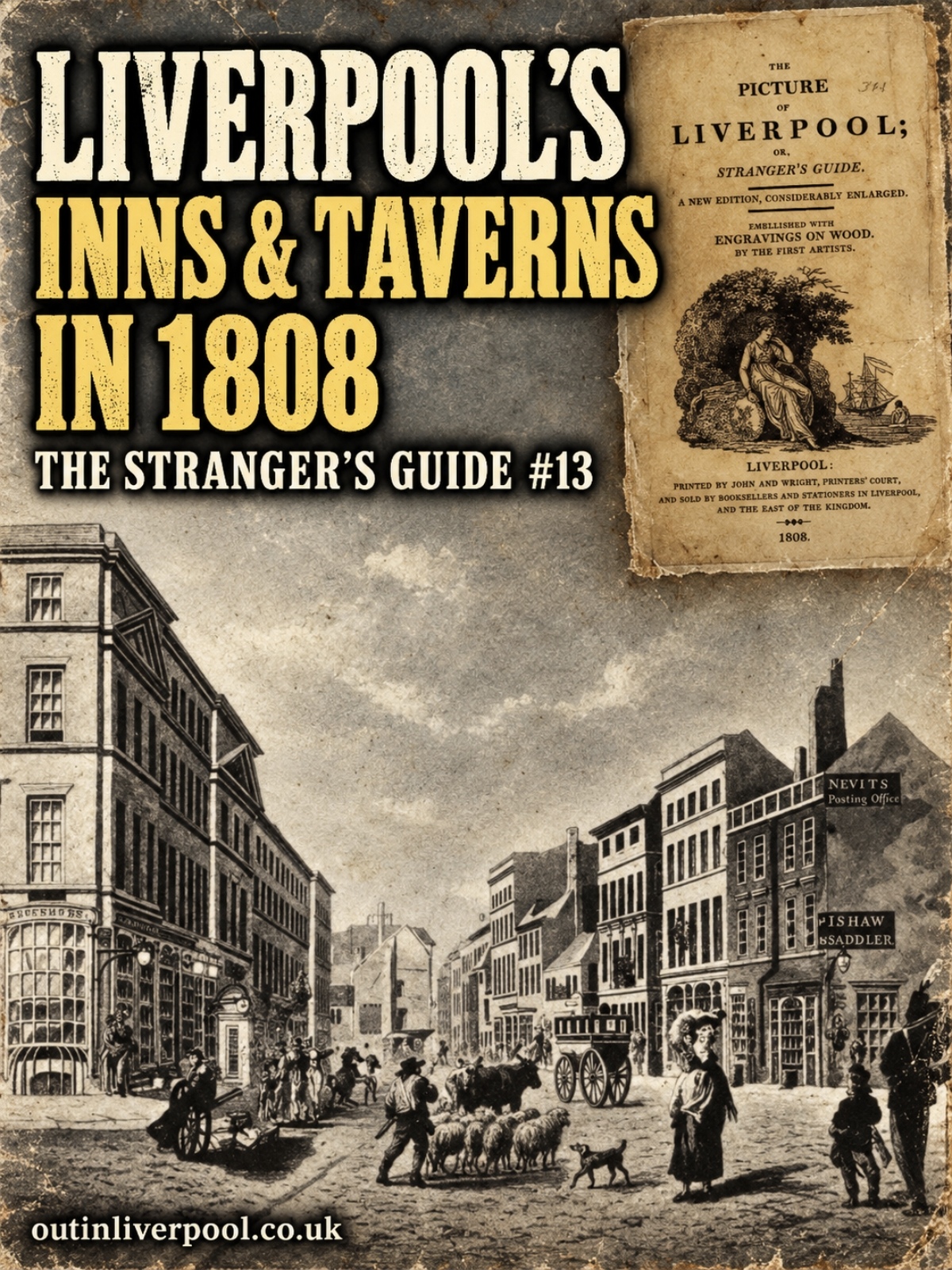
Before Liverpool had railway stations, its inns were part hotel, part dining room, part meeting place — and part transport interchange.
A visitor arriving in Liverpool in 1808 could find a bed, eat at a public table, meet fellow travellers and arrange the next stage of a journey across Britain or towards Ireland. That world appears unusually clearly in the 1808 edition of The Picture of Liverpool; or, Stranger’s Guide. Published in Liverpool by Jones and Wright, the book devoted an entire section to the town’s inns and taverns before moving directly on to stage coaches, Irish packets and ferry boats. [1]
What looks at first like a list of old hotels and drinking houses is actually something more revealing: a glimpse of Liverpool’s lost transport infrastructure.
WHERE A STRANGER STAYED IN LIVERPOOL
Among the most prominent establishments was Lillyman’s Liverpool Arms Hotel in Castle Street. Castle Street already occupied the heart of Liverpool’s commercial district, so a stranger staying there was close to the Exchange, Town Hall, docks and some of the town’s principal shops. The hotel was relatively new when the 1808 guide described its spacious accommodation and furnishings. [1]
Just around the corner, at the bottom of Lord Street, stood Riddiough’s Royal Hotel. The guide presented it as one of Liverpool’s grander establishments, capable of accommodating wealthy families along with their servants, carriages and horses. It also offered a public ordinary — a regular communal meal served at an appointed time. [1]
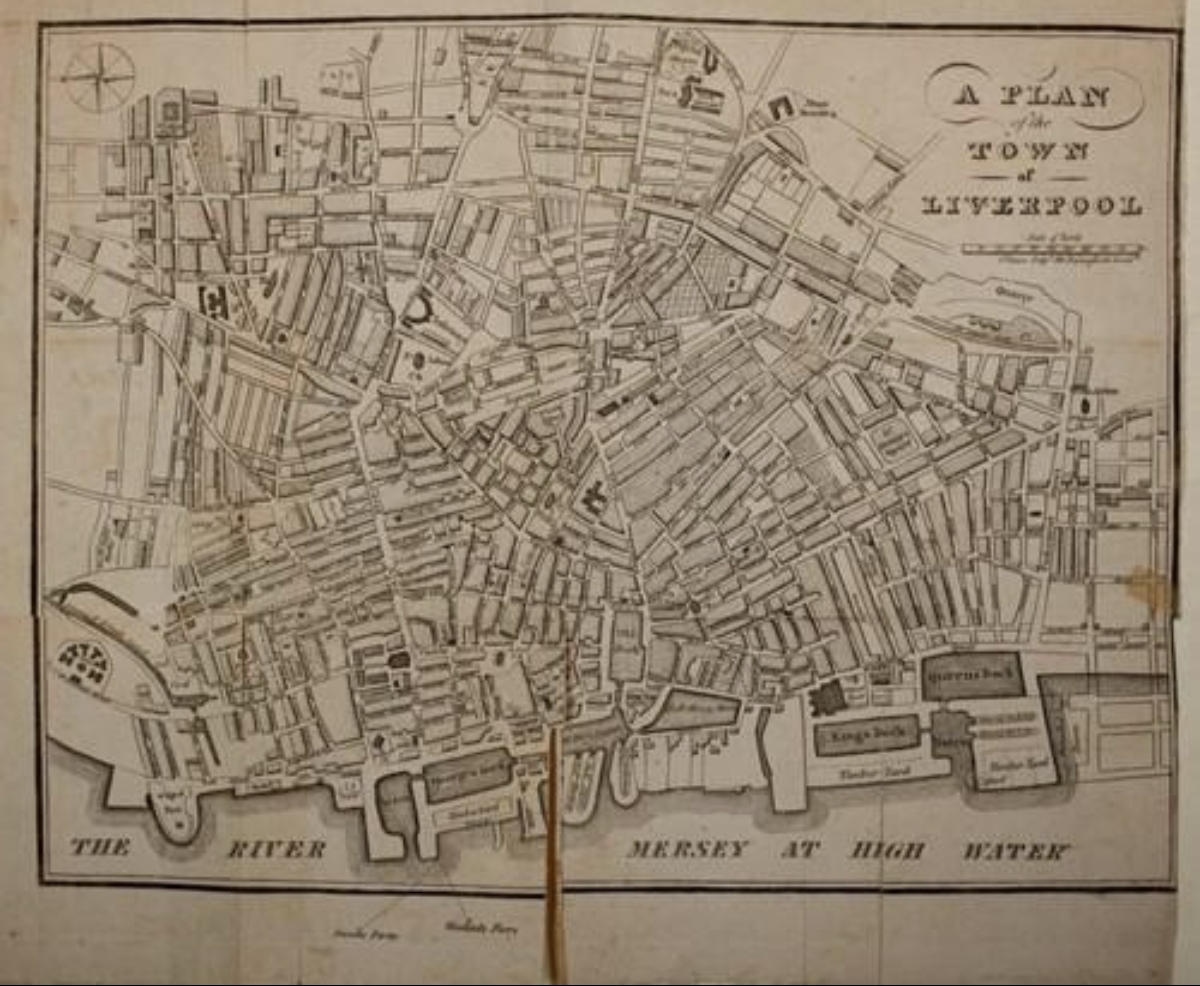
These were not roadside inns on the edge of town. They stood in the middle of a rapidly growing commercial port. As we saw in Liverpool in 1805: A Stranger’s Guide to a Growing Port, Georgian Liverpool was compact: shipping, shopping, public buildings, accommodation and business were crowded into a relatively small area around the centre and waterfront.
WATER STREET — WHERE INNS MET THE ROAD AND THE RIVER
Water Street contained another important cluster. The King’s Arms, near the Exchange, occupied a substantial former merchant’s house. Documentary evidence takes the inn back before the publication of the guide: in 1786 David Dale advertised that he had moved into the former Water Street residence of merchant Thomas Tarleton and opened it as the King’s Arms Inn and Tavern. [2]
By 1808 the King’s Arms formed part of Liverpool’s travelling network. The guide associated it with a journey beginning through Tranmere Ferry and continuing towards Parkgate, Chester, Shrewsbury and Holyhead. A traveller could therefore leave a Liverpool inn, cross the Mersey and continue overland through Cheshire and towards North Wales. [1]
Immediately adjoining it was the Talbot Hotel and London Tavern, associated with the London mail and other coaching traffic and particularly useful to passengers travelling between Liverpool and Dublin. A slightly later Liverpool guide still records the London Mail at the Talbot, showing that this coaching role continued beyond 1808. Liverpool’s inns were therefore connected simultaneously with roads, ferries and the Irish Sea. [4]
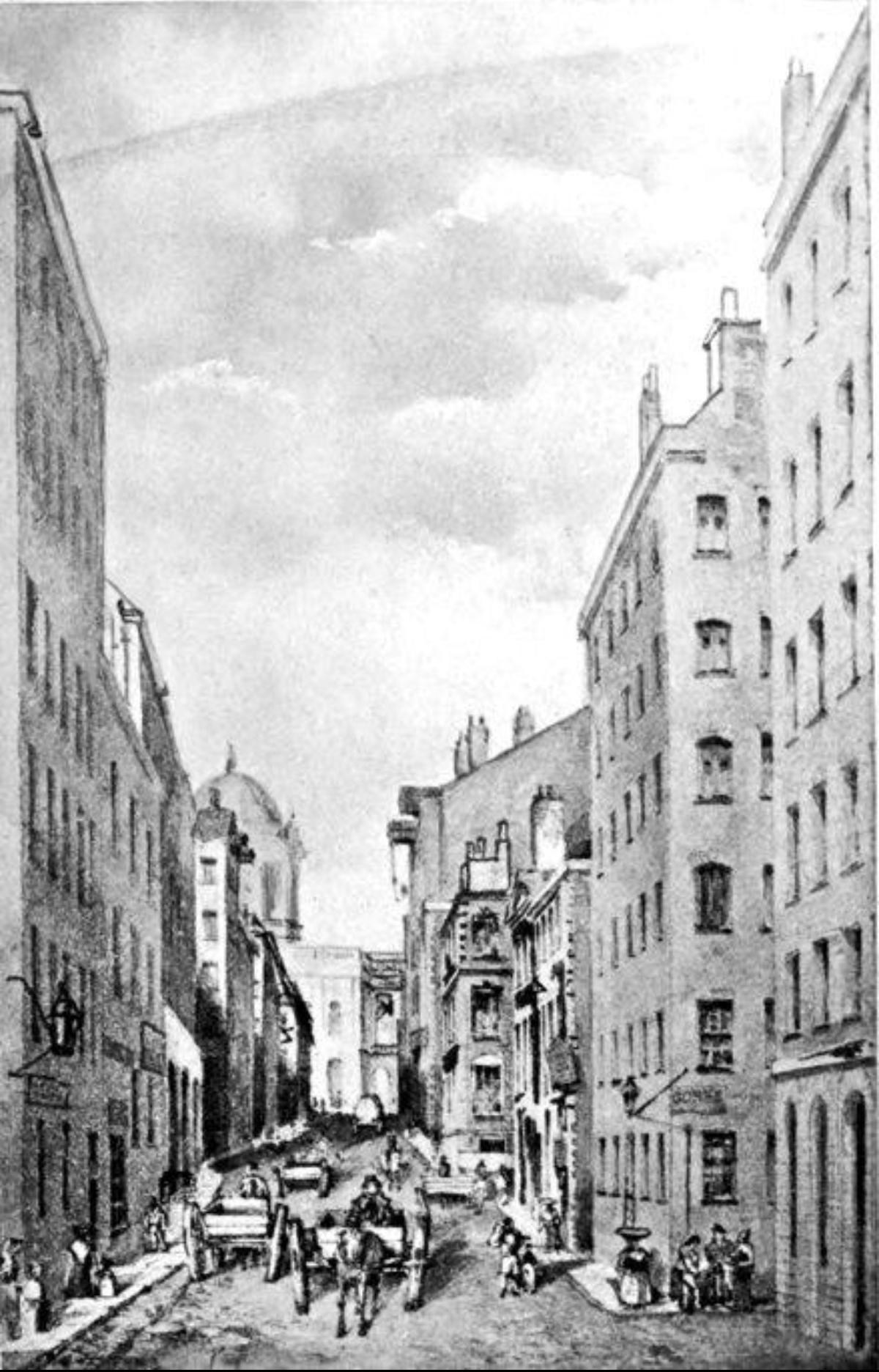
The image is later than the 1808 guide and should not be treated as a picture of the inn exactly as visitors saw it that year. Its value is documentary: Liverpool’s Select Vestry took over the King’s Arms in 1822, and Brierley’s view preserves the former inn building only a generation after the guide described it. [2]
FIVE COACHING HOUSES — AND A MUCH BIGGER NETWORK
At least five establishments named in the 1808 guide can be directly linked with coach traffic. That does not mean Liverpool possessed only five coaching inns; it means these are five houses for which the surviving guide gives us a clear transport connection. The wider network was considerably larger. [1][3]
- King’s Arms, Water Street — route via Tranmere towards Chester, Shrewsbury and Holyhead.
- Talbot Hotel & London Tavern, Water Street — London mail and other coaching traffic.
- Crown Inn, Red Cross Street — London and northern coaching services.
- Golden Lion, Dale Street — Warrington, Manchester and other stage coaches.
- Angel Inn, Dale Street — Warrington and Manchester coach traffic.
The Crown Inn in Red Cross Street was already one of Liverpool’s important coaching establishments around this period, and later research on early Liverpool coaching records a wide range of services operating from the city’s principal inns. [3]
Nowhere was the relationship between accommodation and transport more visible than Dale Street. The guide names the George Inn, Golden Lion and Angel Inn, alongside the many travellers’, carriers’ and coaching houses concentrated in that part of town. The George was described as nearly new and offering good accommodation, but the 1808 material does not give it a specific coach route in the same way that it does the Golden Lion and Angel. Later guides place it within Dale Street’s coaching landscape, but that later evidence should remain separate. [1][4]
The Golden Lion, at the upper end of Dale Street, was already an established landmark. The guide remembered it as having formerly been Liverpool’s largest inn while noting that it still provided extensive accommodation and stage-coach connections towards Warrington, Manchester and elsewhere. The Angel Inn was another busy travellers’ house associated in the 1808 material with Warrington and Manchester. By 1812, guides were recording an even wider selection of services from both establishments. [1][4]
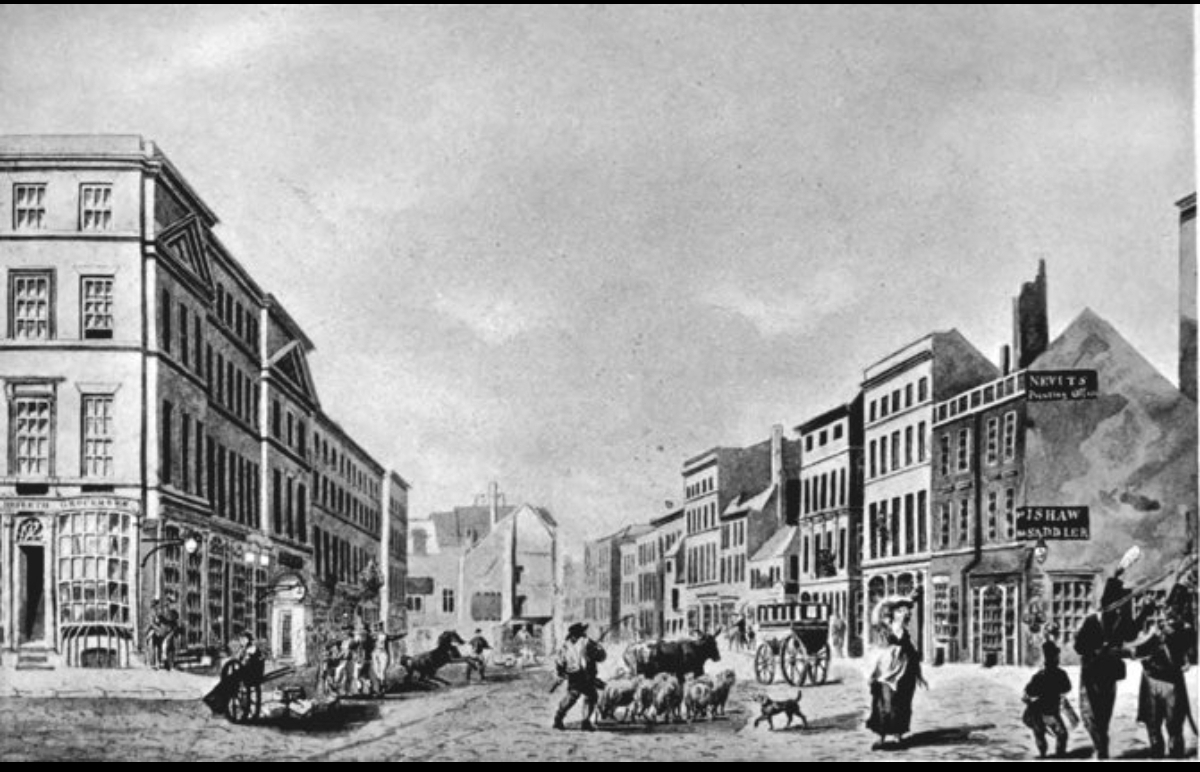
The surviving view gives us something particularly valuable for this series: a genuine near-contemporary image of one of the inns discussed by the guide. Dale Street was effectively one of Georgian Liverpool’s departure concourses — except the “platforms” were inn yards.
TAVERNS, MARINERS AND LIVERPOOL’S TRAVELLING WORLD
Not every establishment performed the same job. The guide also described the American Hotel, near the docks, whose clientele was shaped by Liverpool’s maritime economy. It was associated especially with masters of ships engaged in American trade and provided a coffee room with newspapers as well as accommodation for strangers. A captain arriving from overseas needed somewhere to sleep, eat, read shipping and commercial news, meet contacts and conduct business. [1]
That hotel sat within a much wider Atlantic commercial system. Liverpool’s remarkable growth had been deeply entangled with the transatlantic slave trade and, after Britain abolished its slave trade in 1807, remained connected to colonial commerce and slave-produced commodities. That wider context does not justify assigning individual slavery connections to every inn without evidence, but it formed part of the commercial world in which they operated. [6]
The guide also preserves an important distinction between an inn and a tavern. The Star and Garter in Paradise Street was specifically described as a tavern rather than an inn, offering genteel accommodation for parties, eating and lodging. The Globe Tavern in John Street operated on a similar basis and offered a public ordinary, while the York Tavern in Williamson Square was recommended as a comfortable house. [1]
Georgian Liverpool’s drinking and hospitality culture therefore cannot simply be translated into the modern idea of a pub. Hotels, taverns, coaching inns, coffee rooms and public ordinaries overlapped, but they did not all perform the same function.
Immediately after discussing inns and taverns, the original guide moves on to stage coaches and waggons. That sequence makes perfect sense. Before centralised railway stations, an individual inn might act as hotel reception, restaurant, waiting room, ticket office, coach terminal and information desk all at once. [1]
There was no Lime Street departure board. You needed to know which inn.
DID ANY OF THE 1808 ESTABLISHMENTS SURVIVE?
This is perhaps the most striking part of the story. After checking the establishments named in the 1808 section, I have not found one that can currently be demonstrated to survive today as the same continuously operating inn or tavern on its 1808 site.
That wording matters. Liverpool still has pubs carrying familiar names such as Crown, Globe, Angel or King’s Arms, but names were reused repeatedly. A matching name is not evidence that two businesses are the same establishment.
Some of the 1808 houses can be followed into later history particularly clearly. The King’s Arms ceased operating as an inn when the Select Vestry took over the building in 1822. [2] The coaching landscape of Dale Street was progressively transformed by road improvements, commercial redevelopment and eventually the arrival of the railway, which changed the transport system that had supported the Golden Lion, Angel and other coaching houses. [3][4]
So the Stranger’s Guide is not introducing us to a collection of ancient pubs that somehow survived into modern Liverpool. It is preserving an almost vanished hospitality and transport landscape.
A GUIDEBOOK THAT OUTLIVED THE INNS
There is one particularly good literary afterlife. Herman Melville used the real 1808 Picture of Liverpool while writing his 1849 novel Redburn. In the story, young Redburn carries an old Liverpool guide associated with his father and tries to use it to retrace an earlier visit to the city. Riddiough’s Royal Hotel becomes part of a story about how quickly Liverpool had changed and how unreliable an old guide could become in a city constantly rebuilding itself. [7]
Melville changed the biographical details for fiction, but the guidebook was real — and so were the inns it described.
More than two centuries later, the most striking thing is not how many of those establishments survived, but how completely the system around them disappeared. Coaching gave way to railways, streets were widened, and hotels became shops, offices and banks. Yet in 1808 these houses provided beds, meals, news, horses, coach connections and routes across Britain and Ireland.
Before Liverpool had stations, it had inns.
Citations
SOURCES & FURTHER READING
- The Picture of Liverpool (1808). Jones and Wright, Liverpool. Principal primary source for the inns, taverns, stage-coach connections and 1808 town plan used in this article. Library of Congress.
- Historic Society of Lancashire and Cheshire — Water Street / King’s Arms research. Includes the 1786 King’s Arms advertisement, the 1822 conversion to parish offices and James Brierley’s 1829 view. Historic Society PDF.
- A. H. Arkle — “Early Liverpool Coaching”. Research on Liverpool’s coaching network and principal coaching houses. Historic Society PDF.
- Old-Liverpool — Walk 1812. A useful near-contemporary comparison for Liverpool inns and coach services a few years after the 1808 guide. Old-Liverpool.
- Bygone Liverpool — Dale Street historical image research. Discussion identifying the Golden Lion and other buildings in the 1804 Dale Street view. Bygone Liverpool.
- National Museums Liverpool — Transatlantic slavery collection. Context on Liverpool’s role as a major slaving port and the wealth generated by the trade. National Museums Liverpool.
- Scholarship on Melville’s Redburn and the old Liverpool guidebook. Discussion of Melville’s use of the 1808 guide and Riddiough’s Royal Hotel. Cambridge / PMLA.
Continue the conversation
Share this Liverpool story
Follow Out in Liverpool or bring your own memories, maps and local knowledge to the Community Group.