In 1842, Liverpool opened a building that helped change Britain's approach to public health. But the story of the woman who inspired it — and the people who actually used it — is more complicated than most accounts suggest.
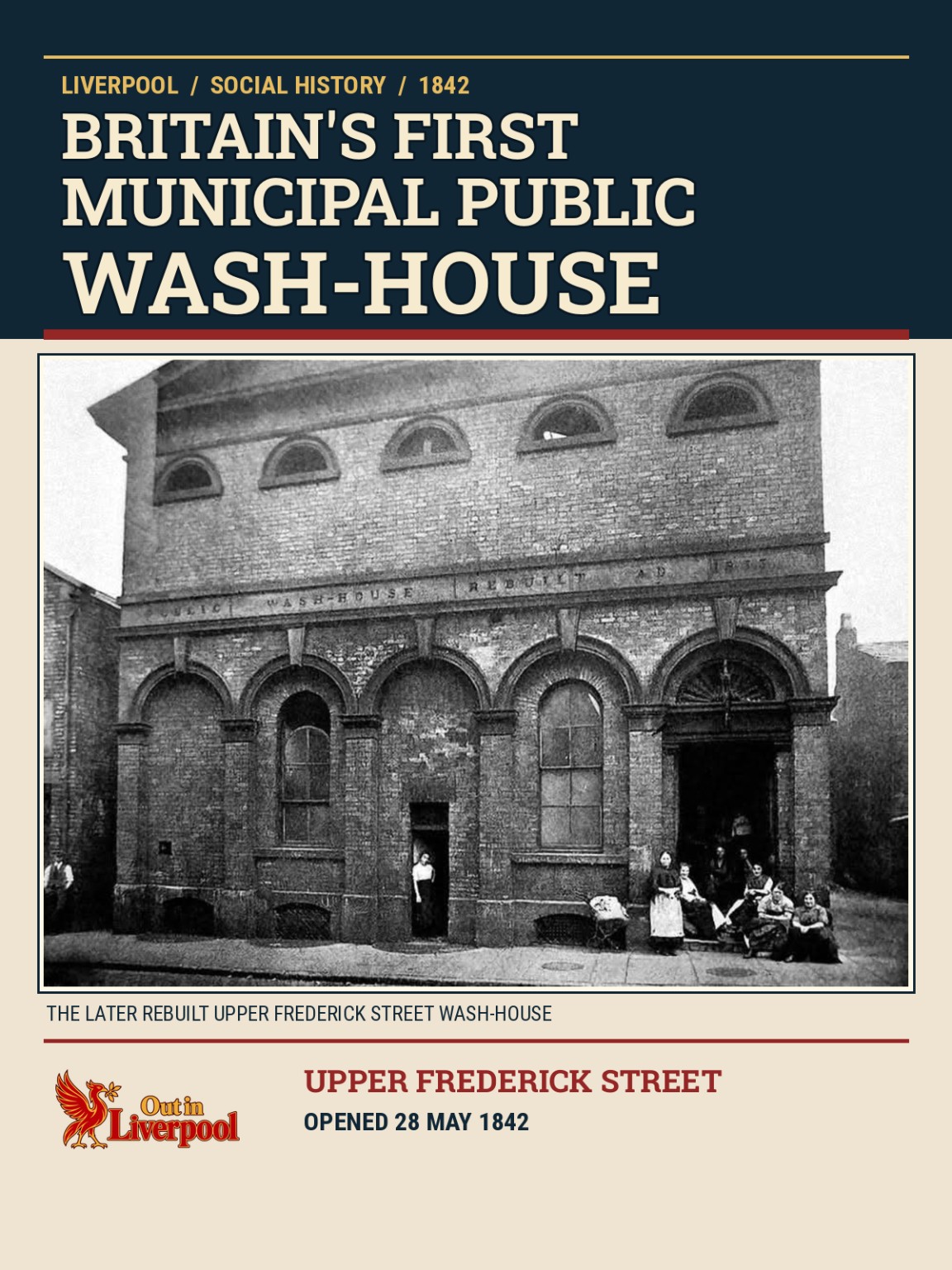
On Saturday 28 May 1842, Liverpool Corporation opened Britain's first municipal public wash-house in Upper Frederick Street.
Inside were washing tubs, boilers, drying facilities and public baths. For families living in overcrowded courts and cellars, it offered something that could be desperately difficult to obtain at home: enough hot water, equipment and space to wash clothing and bedding properly.
This was more than a new public building. It marked an early step towards the principle that local government should help provide the conditions necessary for public health.
Its story involved the cholera epidemic of 1832, the remarkable work of Kitty Wilkinson, Liverpool philanthropists and municipal officials, and an experiment that would influence national legislation.
Yet Kitty was not the first manager, and the wash-house did not always reach the poorest people it was intended to serve.
Both facts are central to its history.
Liverpool's other side: Poverty, overcrowding and cholera
By the early nineteenth century, Liverpool was one of Britain's great commercial ports. The docks brought international trade, employment and enormous wealth, but rapid population growth also created severe pressure on housing and sanitation.
Thousands of labouring families occupied cramped courts, poorly ventilated rooms and damp cellars.
By the middle of the century, approximately 40% of Liverpool's population lived in courts or cellar dwellings, according to figures examined by historian Judith Calvert.
Even obtaining sufficient water could be difficult.
Before 1847, two private companies dominated Liverpool's water supply. Water was delivered irregularly, sometimes for less than an hour and only a few times a week. Landlords' failure to pay water rates could mean supplies being cut off.
For families living in a single room, washing was therefore not simply a domestic chore.
It required water, fuel, soap, suitable equipment and somewhere to dry heavy clothing and bedding.
In 1832, cholera exposed the terrible vulnerability of Liverpool's poorer neighbourhoods.
The epidemic caused 1,523 recorded deaths. Medical understanding remained limited: the transmission of cholera through water contaminated by human waste was not yet established.
But although contemporary explanations of disease were often mistaken, the appalling living conditions were real.
In one of Liverpool's poorest streets, a woman named Catherine Wilkinson decided to help.
Kitty Wilkinson: A wash-house before the Corporation
Catherine Wilkinson, better known as Kitty, was born in Ireland in 1786 and came to Liverpool as a child.
She had experienced considerable hardship, working in domestic service and various other occupations before earning money by taking in washing.
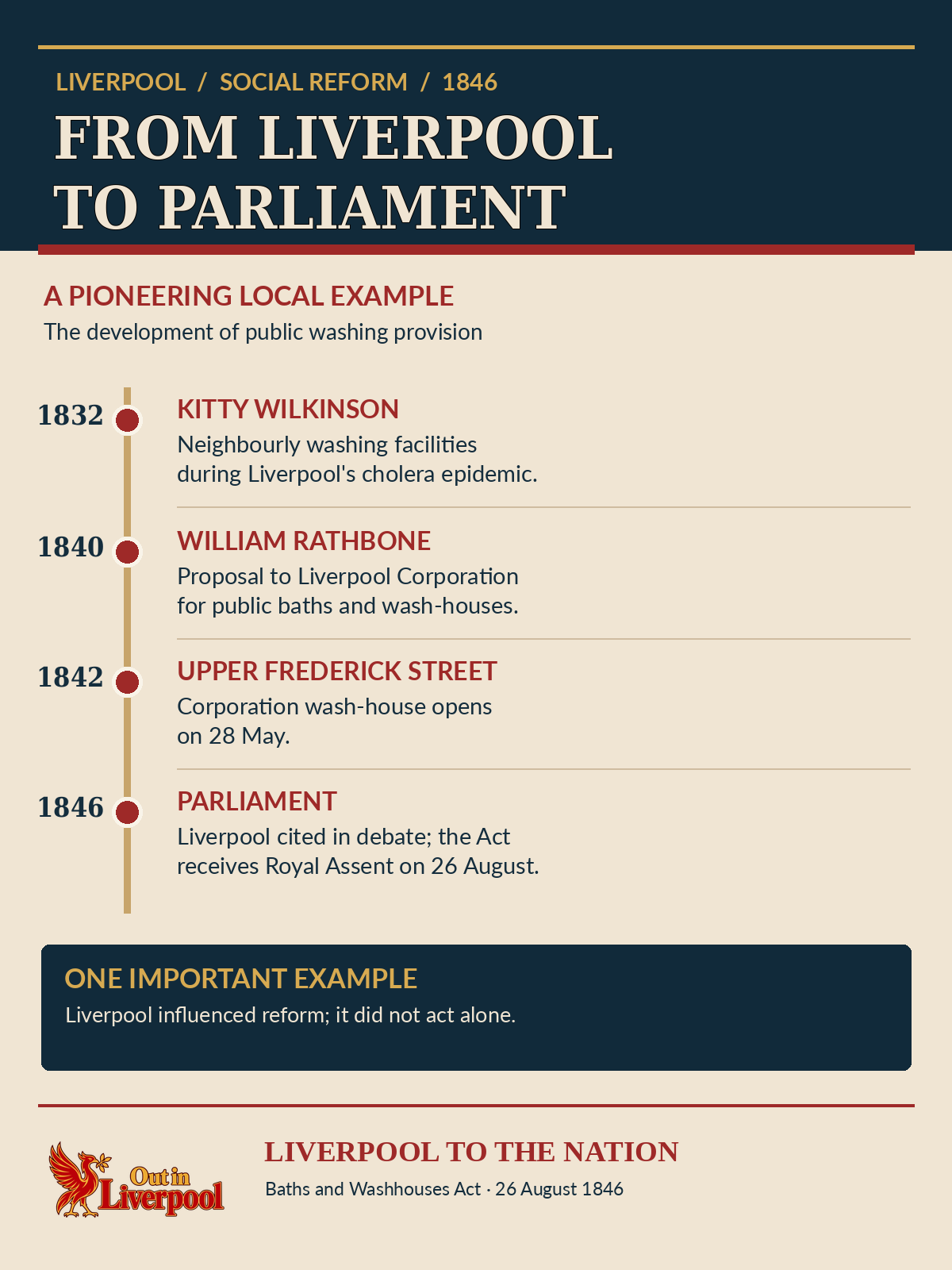
During the 1832 cholera epidemic, Kitty allowed neighbours to use her boiler to heat water and wash their clothing.
Women brought their tubs and worked in the limited space available around her home.
With assistance from the Liverpool District Provident Society and charitable supporters, the arrangement developed into a communal washing cellar.
It was hardly comfortable.
An account published in 1848 described a cellar measuring approximately thirteen feet by ten and a half feet. It contained fourteen washing compartments, a twenty-gallon boiler and rudimentary equipment for carrying and heating water.
The space was dark, damp and frequently filled with steam.
Nevertheless, the arrangement reportedly assisted an average of 85 families weekly over several years.
Kitty supervised the facilities, enforced rules and helped ensure that infected clothing was treated separately.
Her achievement was practical and profoundly important.
She had demonstrated that poorer families needed more than advice about cleanliness. They needed access to the means of achieving it.
But charitable provision was precarious.
A fundraising appeal in June 1837 sought assistance for the washing facilities. The enterprise subsequently closed, despite its demonstrated value.
This earlier charitable establishment must not be confused with the Corporation wash-house that opened five years later.
William Rathbone takes the idea to the Corporation
The efforts of Kitty Wilkinson and her supporters attracted the attention of William Rathbone, a prominent Liverpool reformer.
On 2 September 1840, Rathbone proposed that Liverpool Town Council consider establishing public baths and wash-houses in three districts.
His proposal recognised the difficulties of washing clothing in crowded accommodation.
An accompanying account referred to the earlier charitable washing cellar at 162 Upper Frederick Street, where between 70 and 90 families had reportedly used the facilities each week.
The proposal was not universally welcomed.
Some opponents questioned whether such provision was an appropriate responsibility for the Corporation. Others worried about public expenditure.
Supporters argued that modest admission charges would meet running costs, leaving the Corporation primarily responsible for construction.
The council approved the proposal for further consideration, and preparations began for the first establishment.
Upper Frederick Street was chosen.
A service previously sustained by charity and individual effort would now be financed and administered by local government.
28 May 1842: Britain's first municipal wash-house
The establishment opened on Saturday 28 May 1842.
The Liverpool Mercury confirmed on 3 June that the building, provided at Corporation expense, was already open to the public.
This contemporary newspaper report is important because a later official transcription confusingly gives an opening date of 1 June 1843.
The 1843 statement conflicts with both the newspaper evidence and accounts of the premises' operation during 1842.
The best-supported opening date remains 28 May 1842.
The original building was relatively plain: a two-storey brick structure with accommodation for the superintendent at the front.
The wash-house occupied the rear cellar.
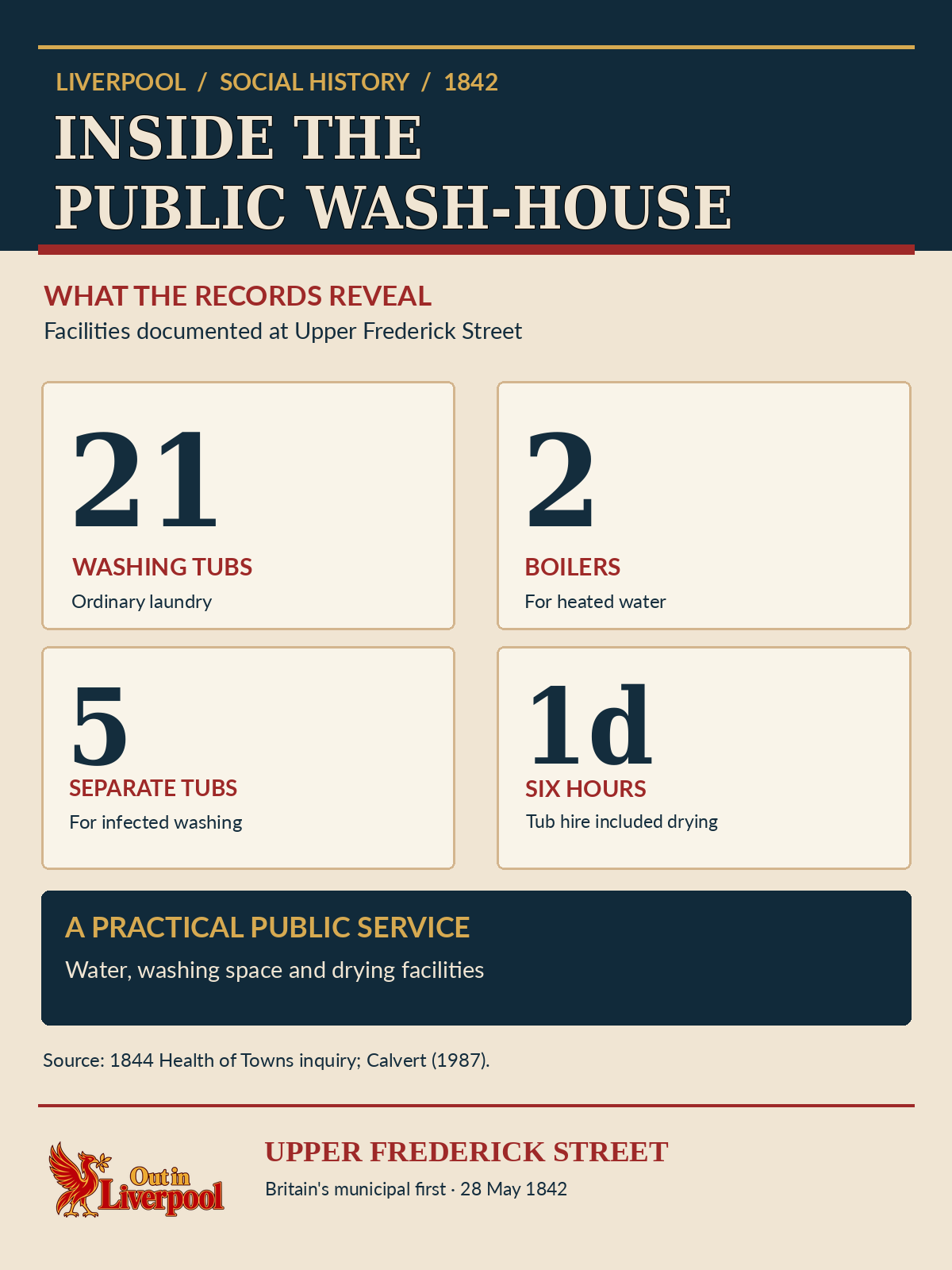
It contained twenty-one ordinary washing tubs and two boilers. A separate building accommodated five additional tubs for handling infected clothing.
This distinction explains why some contemporary accounts mention twenty-one tubs while others count twenty-six.
The premises included drying equipment and bathing facilities.
It was not Britain's first communal laundry, nor the country's first public bathing establishment. Liverpool itself already had a municipal bathing history stretching back several decades.
Its particular distinction was being Britain's first public wash-house established by a municipal corporation.
Inside the wash-house: A penny for six hours
Women arriving with their washing found twenty-one tubs supplied with hot and cold water.
The original regulations allowed each woman to use a tub for up to six hours for one penny, including water and drying facilities.
The drying closet contained five large sliding iron frames, but demand soon demonstrated that the accommodation was inadequate.
The Corporation also faced an unexpected difficulty: unreliable water supplies.
By 1846, the establishment was using approximately 1,638,000 gallons annually, under a contract costing £52 10s a year.
Yet complaints about irregular deliveries had already arisen in October 1842.
Even Liverpool's pioneering municipal wash-house could struggle to secure the basic resource upon which it depended.
Regulations attempted to ensure orderly use.
When no tub was available, women were served in order of application. Those occupying cellars or single rooms were supposed to receive priority, particularly if they had large families and limited means.
Infected clothing was handled separately, with the matron required to supervise its receipt and treatment. Families could obtain assistance without charge on production of an appropriate medical or charitable certificate.
These arrangements reflected the establishment's dual purpose: providing affordable domestic facilities while reducing some of the hazards associated with infectious disease.
Bathing was also popular.
A September 1842 newspaper report recorded 439 bathers in one week.
The original accommodation was subsequently expanded. Later descriptions give eighteen private baths, with a vapour bath introduced in 1844.
The baths offered different levels of privacy and comfort at different prices, creating a class-based service even within a reform intended to improve public access.
The forgotten first managers: Andrew and Mrs Clarke
For many years, accounts of the wash-house implied that Kitty Wilkinson became its first manager in 1842.
The Corporation's records establish otherwise.
The posts of superintendent and matron were advertised publicly, attracting 104 applications.
Andrew Clarke and his wife were selected on 20 April 1842, and their appointment was formally approved by Liverpool Town Council on 6 May.
Their recommended annual salaries were £60 and £30 respectively.
They supervised the premises, managed admission and ensured the facilities operated effectively.
In June 1846, the Corporation commended their work and transferred them to the larger new establishment at Paul Street.
They had managed Liverpool's pioneering municipal wash-house throughout its first four years.
Their contribution deserves recognition, particularly that of Mrs Clarke, whose individual name has not been established from the appointment records consulted.
Kitty Wilkinson becomes superintendent in 1846
The Clarkes' departure created an opportunity for Kitty Wilkinson.
William Rathbone supported her application, drawing attention to her earlier work and practical experience.
On 2 September 1846, Liverpool Town Council approved the appointment of Catherine and Thomas Wilkinson to Upper Frederick Street.
Kitty was now officially managing the Corporation establishment whose creation her earlier initiative had helped inspire.
Thomas died in January 1848.
Kitty successfully applied to continue managing the premises, with assistance from a suitable person approved by the council.
She remained in charge until the original wash-house closed for redevelopment in April 1851.
Recognising this chronology does not diminish Kitty's importance.
It distinguishes the woman who pioneered communal washing during the cholera crisis from the managers appointed when the Corporation opened its own service.
A pioneering service — but not a financial success
Liverpool's municipal experiment attracted considerable attention, but it did not immediately pay for itself.
The original capital expenditure was £2,648 9s 2d.
Judith Calvert's examination of the accounts shows that during the first two years, average annual maintenance expenditure reached approximately £287.
Average annual receipts amounted to £219 16s 7d.
The resulting shortfall was £67 3s 5d a year.
The Corporation therefore faced a difficult question: should a public-health service be expected to cover its costs?
Increasing admission charges risked excluding the people who needed the facilities most.
The problem became especially apparent when bathing charges rose in September 1843.
Demand subsequently declined, particularly for lower- and middle-priced baths.
By June 1845, the municipal committee itself questioned whether increasing charges had been wise.
Prices were subsequently reduced.
Liverpool had demonstrated that public provision was possible. It had not discovered an easy way to reconcile accessibility with financial self-sufficiency.
Did Liverpool's poorest families really benefit?
Perhaps the most revealing evidence comes from James Newlands, Liverpool's Borough Engineer.
In a report published in 1856, Newlands examined 1,005 users of the Frederick Street wash-house, which by then occupied the rebuilt premises.
He recorded 470 washerwomen, 303 householders and 232 servants.
Among the householders, 87 were classified as very poor.
That amounted to approximately 8.7% of all surveyed users.
The figure does not tell us the financial circumstances of every washerwoman or servant. Nevertheless, Newlands believed the wash-houses were failing to reach many of the families for whom the movement had originally been intended.
Why might that have happened?
Some poorer families could not afford soap or the admission charge. Others had little spare clothing to wash.
Women caring for children or elderly relatives could struggle to leave home for several hours.
There may also have been social pressures associated with being visibly identified as poor.
Calvert's later historical interpretation emphasised that poverty itself could prevent families from using a service designed to help them.
This finding complicates the story, but makes it more valuable.
Providing a public service did not automatically make it accessible to everyone who needed it.
Liverpool's example reaches Parliament
Despite these limitations, Liverpool's experiment influenced the growing movement for public baths and wash-houses across Britain.
On 8 June 1846, the Bishop of London addressed the House of Lords on the importance of such establishments.
He cited Liverpool's example, reporting 3,882 cold bathers and 16,704 warm bathers for the year ending 28 May 1844.
He also discussed charitable establishments in London, demonstrating that sanitary reform was becoming a national concern.
On 19 June 1846, Home Secretary Sir George Grey introduced legislation designed to encourage local authorities to provide baths and wash-houses.
Grey referred specifically to Liverpool, describing its scheme as self-supporting.
That parliamentary description should be understood in context: the original establishment's first two years had produced an operating shortfall.
Nevertheless, Liverpool had supplied a practical example of municipal provision.
The Baths and Washhouses Act received Royal Assent on 26 August 1846.
It empowered qualifying local authorities to establish facilities and arrange funding, although it did not require every town to do so.
Liverpool did not single-handedly cause the legislation.
But its pioneering work helped demonstrate what local government could achieve.
Rebuilding and the end of Upper Frederick Street
The original Upper Frederick Street establishment closed on 22 April 1851.
The Corporation proceeded with redevelopment, accepting a rebuilding tender in 1852.
The replacement building is commonly dated to 1853 and reopened on 1 May 1854, with John Clarkson and his wife appointed to manage it.
Kitty Wilkinson did not return.
The council subsequently arranged employment for her mending and hemming towels for the municipal baths, at twelve shillings a week.
She died on 11 November 1860 and was buried in St James' Cemetery.
The rebuilt wash-house continued serving Liverpool for decades.
It finally closed in February 1925, when the newly constructed Gilbert Street wash-house replaced it.
Liverpool's pioneering municipal service had endured for more than eighty years.
Remembering the people behind Liverpool's first
Kitty Wilkinson deserves an important place in Liverpool's social history.
Her generosity, determination and practical understanding helped demonstrate the value of communal washing facilities.
But the full story involved many people.
Charitable supporters helped maintain the original arrangements. William Rathbone pressed for municipal intervention. The Corporation funded the building. Andrew and Mrs Clarke managed the first public establishment.
Catherine and Thomas Wilkinson subsequently continued that work.
And the women who carried baskets of washing through its doors made the establishment part of everyday life.
Their contribution is easily overlooked when history focuses only on buildings, officials and reformers.
A Liverpool first worth remembering
Liverpool's achievements are often measured through docks, railways, international commerce and grand architecture.
Upper Frederick Street belongs to another history.
It tells us how working people struggled with overcrowding, illness and inadequate domestic facilities — and how charity gradually gave way to municipal responsibility.
The wash-house was imperfect. It cost public money, experienced operational difficulties and did not always reach the poorest families.
But it introduced an important principle.
Cleanliness should not simply be demanded of those living in poverty. People should have the facilities needed to achieve it.
Liverpool's first municipal public wash-house was more than a building filled with tubs and boilers. It was an early experiment in making public health a shared civic responsibility.
When we celebrate Liverpool's greatest achievements, shouldn't we also remember the places that helped make ordinary people's lives better?
Historical evidence
Sources & further reading
- Judith Calvert, “The Means of Cleanliness” (Transactions of the Historic Society of Lancashire and Cheshire, vol. 137, 1987)
- John Dobie, “Kitty Wilkinson: A Civic Myth” (municipal minutes and contemporary newspapers transcribed)
- Baths and Wash Houses Historical Archive — Liverpool chronology
- House of Lords, Public Baths and Washhouses, 8 June 1846
- House of Commons, Public Baths and Washhouses, 19 June 1846
- Baths and Washhouses Act 1846
- Historic England / Merseyside HER MME17859
- Historic England, Building a Better Society
Calvert's study cites Liverpool Corporation minutes and contemporary official inquiries. The original council minute books and historical photographs have not all been inspected directly for this article.
Historical image credits
Hero: a historical photograph of the later rebuilt Upper Frederick Street wash-house, reproduced in the Out in Liverpool approved graphic. It does not depict the original 1842 building. The original photographer, archival accession number and reproduction permission have not been independently established. The two supporting graphics are modern documentary information designs by Out in Liverpool; neither is a Victorian illustration.
Continue the conversation
Share this Liverpool story
What other overlooked achievements in Liverpool's social history deserve more recognition?