
Gilbert Tait Stewart: The Liverpool Merchant Whose Name Survived in Ghana
From Old Hall Street to the Gold Coast, a family archive reveals the life of a merchant, the company he helped establish in Accra and the Liverpool connections that survived across generations.
In 2019, architectural research in Accra, Ghana, recorded something remarkable on the exterior of an old commercial building. Still visible on its frontage was the name Arbour & Stewart, a produce-trading firm established more than a century earlier.
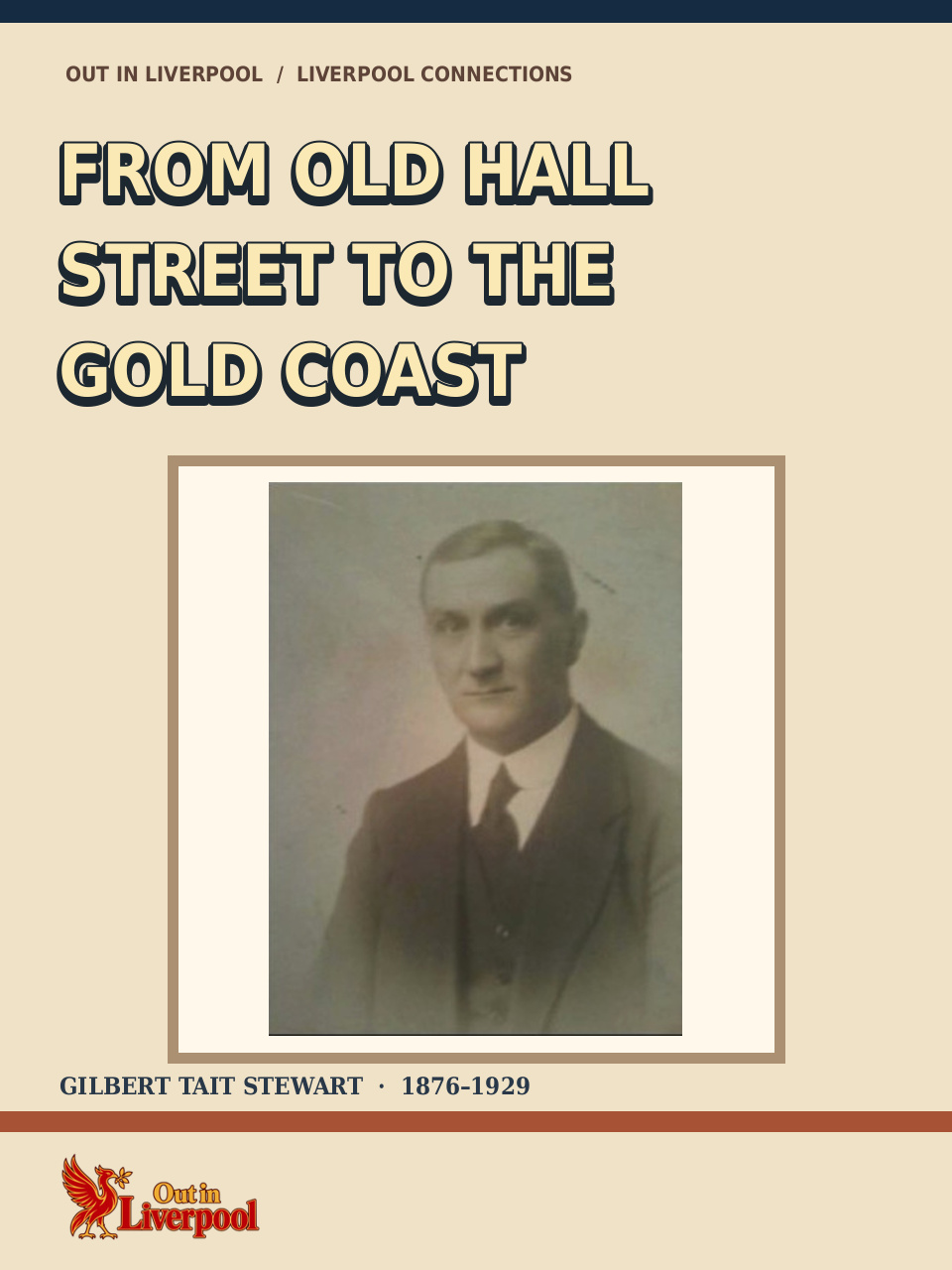
One of the men behind that business was Gilbert Tait Stewart, born in Glasgow in 1876 and later closely associated with Liverpool's international trading community. He died in 1929, aged just 52, leaving behind a family whose history crossed the Mersey and the trading ports of West Africa.
The surviving company name is an extraordinary physical link to his past. But it is only one part of a larger story, reconstructed through contemporary business publications, parish registers, shipping records, photographs and documents preserved by Gilbert's granddaughter, Veronica St George-Yorke, known as Vera. Those sources also illuminate Gilbert's wife Mabel, the Stringer family of Liverpool and the generations who kept their history alive.
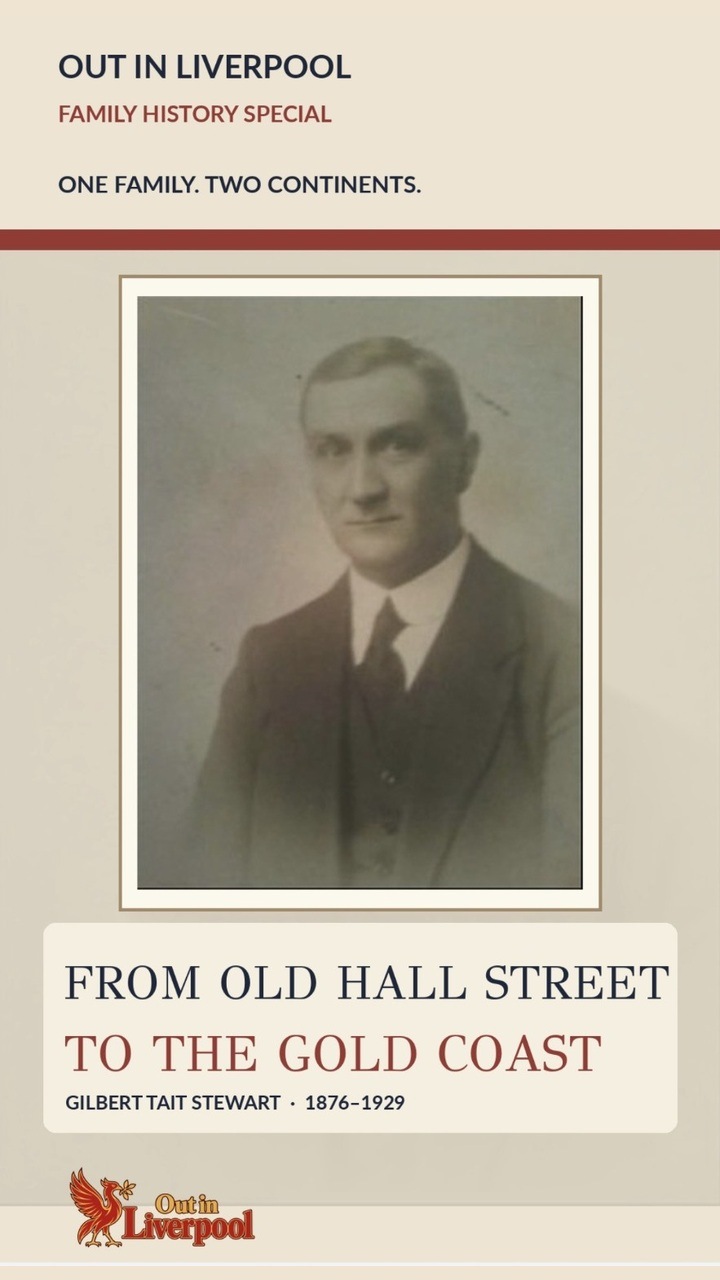 WATCH THE DOCUMENTARYFrom Old Hall Street to the Gold Coast2 minutes 9 seconds · Authentic family photographs · Narrated short film▶ Watch on YouTube
From Glasgow to Liverpool's commercial streets
Gilbert Tait Stewart was born on 22 June 1876 at 139 Berkeley Street, Glasgow. His Scottish statutory birth extract names his father as James Stewart, a drapery warehouseman, and his mother as Isabella Stewart, whose maiden surname was Lapsley. His parents had married in Glasgow on 25 June 1875. [1]
The family subsequently became established in Liverpool. Family recollections associate the Stewarts with Bedford Street South and, later, Mossley Hill. These memories place them within a city whose nineteenth-century commerce depended heavily on its shipping, manufacturing and merchant networks.
Liverpool's commercial relationships with West Africa were well established by the time Gilbert began his working life. The waterfront was surrounded by shipping offices, warehouses, agents and merchant houses involved in movements of commodities between Britain and overseas markets. Old Hall Street formed part of that commercial district. The family remembers Gilbert's association with a businessman named Henry Jones and offices at 45 Old Hall Street, reportedly photographed by a relative before the building's demolition.
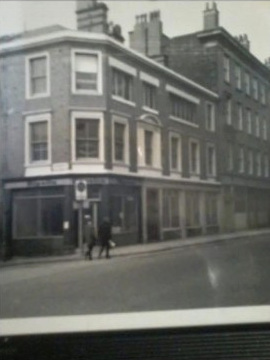
An 1894 edition of Kelly's Liverpool directory confirms that 45 Old Hall Street was a commercial address, listing a receiving warehouse used by Thompson, McKay & Co. That tells us about the premises, but not who occupied them when Gilbert was connected with the area. The family photograph is a valuable historical source; its precise building identification remains unverified. [2]
A contemporary account in The Red Book of West Africa (1920) places Gilbert on the Gold Coast, now Ghana, from 1896. The entry also refers to Messrs Jones, Son & Co. in connection with Cape Coast Castle. This is broadly compatible with family recollections of a career associated with a Jones business, although the precise relationship between the Liverpool employer and the Gold Coast firm has not been established. [3]
Arbour & Stewart: A merchant business in Accra
In 1914, Gilbert entered into partnership with a merchant identified in contemporary records as H. Arbour. Their firm, Arbour & Stewart, operated from Bannerman Road in Accra, then part of Britain's Gold Coast colony. The business featured in The Red Book of West Africa in 1920, accompanied by printed portraits of its partners.
The directory describes produce merchants dealing particularly in cocoa and other agricultural commodities, with approximately twenty depots associated with the railway network. This suggests a substantial collecting and distribution operation, but the directory was partly promotional literature rather than an audited financial report. Its claims should not be converted into precise turnover figures or into ownership of twenty railway stations. [3]
The business must also be understood within the wider economy of the Gold Coast. During the late nineteenth and early twentieth centuries, African farmers invested extensively in cocoa cultivation, creating an industry that connected villages and inland markets with coastal traders and overseas companies. Local buyers, carriers, transport workers and farmers were essential to that development. European merchants participated in purchasing, finance, storage and exports, but the cocoa economy was not their achievement alone. [4]
Gilbert's company formed part of this broader commercial network and of the inequalities of colonial trade. British commercial publications often foreground European merchants and premises, while providing far fewer individual accounts of the African producers on whose work the trading businesses depended. A history of Arbour & Stewart should recognise both the named merchant partners and those less visible people.
The 1920 directory also offers clues to Arbour's earlier career. It describes him as a London-born merchant who began business in 1874, arrived on the Gold Coast in 1902 and worked with F. O. Abraham in establishing the Tarquah Trading Company. He reportedly managed that enterprise before forming his partnership with Gilbert. The two companies were separate businesses and their premises should not be confused. [3]
Tarquah Trading Company had its own later history, including sponsorship of early commercial recordings of Ghanaian music in London during the late 1920s. There is no verified evidence that Gilbert personally organised those recordings. They provide context for an interconnected trading world, but not a reason to attribute every later activity of Tarquah Trading to Arbour & Stewart.
A name preserved on a building in Ghana
One of the strongest pieces of evidence for the firm is architectural. In 2019, University of Liverpool architectural historian Iain Jackson published Sharing Stories from Jamestown: The Creation of Mercantile Accra, examining historical photographs, buildings and the development of Accra's trading districts.
Among the buildings documented was a former commercial premises associated with Arbour & Stewart. Figure 102, on printed page 89, shows the company name still visible on the exterior in 2019. For a family reconstructing the life of an ancestor whose business had largely slipped from memory, it offered a striking link between an old Liverpool-connected firm and the modern Ghanaian city. [5]
This also shows why architectural heritage matters. Streets and buildings sometimes preserve evidence of relationships that have disappeared from written histories. The building belongs to Accra's own heritage, shaped by generations of Ghanaian residents, workers and enterprises as well as the British-era firms whose names once appeared on commercial frontages.
The photograph documents the lettering in 2019, not necessarily its condition today. Nor does the research establish a definitive later owner or legal successor to Arbour & Stewart. Those questions require separate company records.
Letters and steamships: A life between two continents
A second tangible survival comes from postal history. In a 2002 article for Cameo, the West Africa Study Circle's journal, Nick Carter reproduced a 1916 commercial envelope carrying the printed name Arbour & Stewart. The envelope travelled from Accra to New York. Its contents have not been established, but the cover proves that the firm used its trading identity in international correspondence during the First World War. [6]
For Gilbert, journeys by sea formed a recurring part of working life. Vera's family archive includes Ancestry passenger-list indexes associated with the vessels Elmina, Abosso, Mandingo, Adriatic and Aba. Among the recorded movements are an arrival at Liverpool on Elmina in August 1913; a departure on Abosso in October 1916, with Accra recorded as the destination; and arrivals connected with Mandingo in 1919 and Aba in 1923. [7]
These are index entries rather than a complete set of inspected original manifests. A vessel's itinerary does not always establish exactly where an individual passenger boarded and disembarked. Even so, the records give an unusually clear impression of a life conducted between the Mersey and overseas trading ports. The ships connected offices and merchants with cargoes, correspondence and commercial partners thousands of miles away.
A separate family-preserved Freemasonry index records Gilbert's initiation in July 1900 and describes his occupation as African Agent, with lodge number 1356, identified as Toxteth Lodge. The original membership register has not yet been inspected, but the entry is another early clue to his association with African trade.
Mabel Beatrice and the Stringer family
The business papers concentrate on Gilbert and his partner, but the surviving Liverpool family records offer a richer picture. Gilbert's wife was Mabel Beatrice Stewart, née Stringer, born in 1882 according to the family tree. Family recollections suggest that they met at a musical recital at St George's Hall in 1911. That particular event remains family testimony, and their own marriage registration has not yet been obtained.
A more firmly documented event came on 3 August 1913, when their daughter Mabel Isabel Tait Stewart was baptised at All Hallows Church in Allerton. The published parish transcription names Gilbert and Mabel Beatrice as her parents, gives their home as 11 Hallville Road and records Gilbert's occupation as merchant. It anchors the family in Liverpool at a time when his commercial interests were already overseas. [8]
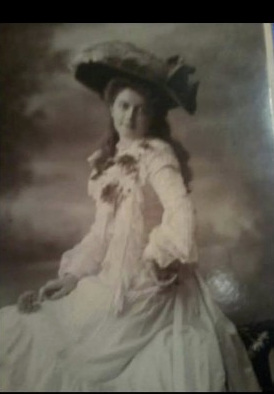
The family tree also identifies sons Gilbert Lapsley Stewart and George Henry Stewart. These details extend the story into the generations who preserved the photographs and documents, although some individual dates still depend upon the family's own records.
Mabel provides an important link between the Stewart and Stringer families. Vera's newly shared Ancestry tree identifies her as a daughter of Hiram Stringer (1852–1933). An independent 1920 parish marriage transcription records Gertrude Mary Stringer marrying James Craig Dumbreck at All Hallows on 19 June. Her father is named as Hiram Stringer, merchant, and a witness is named Mabel Beatrice Stewart. The bride's address was Cartref, Allerton Road. [9]
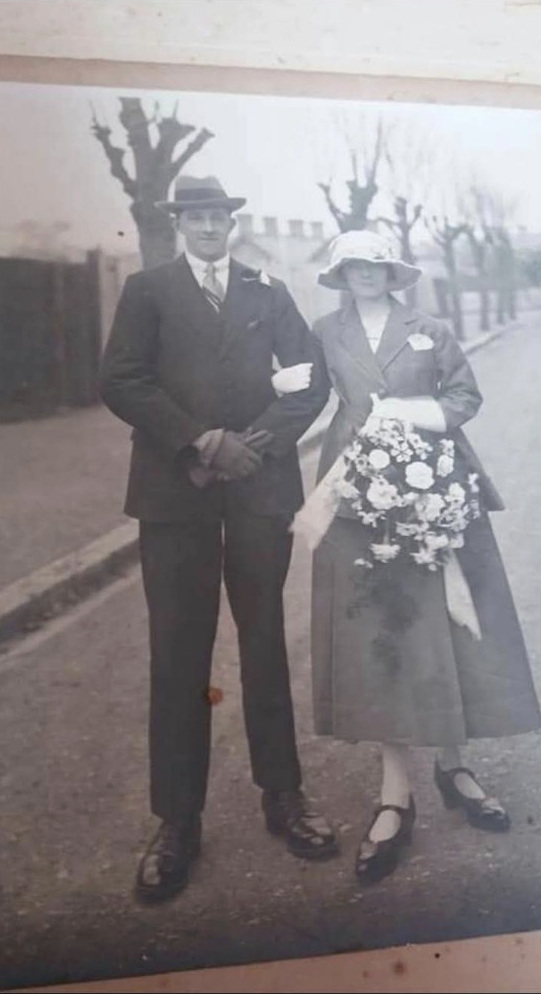
That witness entry is a valuable documented association between the Stewart and Stringer names. Combined with Vera's family research, it makes the reported family connection persuasive, though it does not replace Gilbert and Mabel's missing marriage document or prove every link in the contributed family tree.
There is also a possible connection with Liverpool's nineteenth-century retail trade. Kelly's Directory for 1894 lists Hiram Stringer, fancy repository, 45 Church Street, along with another trading entry in that name elsewhere in the city. Whether these entries identify the same individual or the Hiram shown in Vera's family tree remains unresolved. The Church Street business should therefore be presented as a significant research lead, not a proven family enterprise. [10]
Mabel's place in the surviving records extends beyond the marriage and baptism entries. She was present when Gilbert died in 1929 and was named as the informant on his death certificate. The family tree records her own death in 1944. Her experiences during the intervening years are much less documented, but it is through Mabel, their children and subsequent generations that the story continued to be preserved.
War, bereavement and the final years
The family also suffered a loss during the First World War. Vera identifies Gilbert's brother as Claud Lapsley Stewart, an Engineer Commander in the Royal Naval Reserve. Claud died on 13 June 1918 when HMS Patia was torpedoed in the Bristol Channel. The London Gazette of 21 June 1918 recorded him as mentioned in despatches for patrol-cruiser service in 1917. That was recognition of earlier service, not an award made specifically for the ship's sinking. [11]
In 2019, Claud's name was among the additions to Liverpool Town Hall's First World War Roll of Honour. Vera participated in the commemorative occasion, reconnecting another generation of the family with his story. His naval career and the loss of Patia deserve a dedicated feature in their own right. [12]
Gilbert died on 11 April 1929, aged 52, in Bebington-cum-Bromborough. The death-register extract described him as an African Merchant and recorded the cause of death as epithelioma of the tonsil, a form of cancer. His widow Mabel Beatrice was present and named as the informant. Vera has confirmed the family's final address as 42 Euston Road. [13]
The continuing use of African Merchant as his occupation is a succinct reminder of how deeply the Gold Coast trade had shaped his adult life. Family recollections describe financial difficulties following his death, but the specific circumstances have not been established. The Wall Street Crash came later that year; there is no documentary basis for treating it as a proven cause of the family's problems.
Nor has the eventual fate of Arbour & Stewart been conclusively traced. The firm may have continued under new management, changed hands or ceased trading. Without company records establishing that sequence, the later history remains an open question.
More than a name in a directory
Gilbert Tait Stewart was not one of Liverpool's best-known merchants, and his importance should not be exaggerated. The value of his story lies in the unusual range of evidence surviving around an individual life. A birth certificate identifies his parents in Glasgow, a parish register places his family in Allerton, a commercial directory names his business in Accra, and passenger indexes reveal journeys across the sea.
Family photographs introduce the people behind those records. The Stringer evidence opens another part of Liverpool's commercial and social history, while the name photographed on a building in Ghana in 2019 connects the research with physical heritage thousands of miles from the Mersey.
There are still unanswered questions: the precise Old Hall Street occupancy, the identification of Hiram Stringer in the Church Street directory and the firm's eventual fate all require more evidence. These limits do not lessen the story. They demonstrate the difference between carefully reconstructing history and inventing certainty where records are missing.
Gilbert died in 1929, but his story did not disappear with him. It survived in photographs, certificates, parish entries, shipping records and, remarkably, in the name of a company still visible in Accra ninety years later. Almost a century after his death, those fragments have come together to reveal a family history that stretched far beyond Liverpool.
Out in Liverpool thanks Veronica St George-Yorke and her family for generously sharing their photographs, historical records and recollections, and for permitting their use in telling this story.
Does your family have photographs, letters or memories connected with Liverpool's West African trading houses, Old Hall Street, Church Street or the ships that sailed from the Mersey? We would be pleased to hear from you.
Sources and further reading
- Scottish statutory birth-register extract, Gilbert Tait Stewart, Kelvin district, Glasgow, entry no. 67 (1876). Family-held certified extract photographed for this research.
- Kelly's Directory of Liverpool and Birkenhead, 1894, listing Thompson, McKay & Co. at 45 Old Hall Street. University of Leicester digitisation.
- **Allister Macmillan (ed.), *The Red Book of West Africa***, 1920, p. 179, illustrated Arbour & Stewart entry. Google Books record.
- Historical scholarship on Ghanaian cocoa farming and trade, including economic history research and African commercial agency.
- **Iain Jackson, *Sharing Stories from Jamestown: The Creation of Mercantile Accra***, Liverpool School of Architecture / TAG Press, 2019, pp. 88–90, figure 102. Read the publication.
- Nick Carter, "Gold Coast Short Payment", Cameo, West Africa Study Circle, January 2002, pp. 150–151. Read the issue.
- Family-preserved Ancestry passenger-list indexes, 1913–1923. Original passenger manifests not all examined.
- All Hallows, Allerton, baptism, Mabel Isabel Tait Stewart, 3 August 1913, entry 654. Lancashire Online Parish Clerks.
- All Hallows, Allerton, marriage, Gertrude Mary Stringer and James Craig Dumbreck, 19 June 1920, entry 246. Lancashire Online Parish Clerks.
- Kelly's Directory of Liverpool and Birkenhead, 1894, p. 728, Hiram Stringer entries. University of Leicester scan.
- The London Gazette, supplement of 21 June 1918, p. 7303, Claud Lapsley Stewart. Official record.
- Liverpool City Council, 2019, First World War names added to Liverpool Town Hall Roll of Honour.
- English statutory death-register extract, Gilbert Tait Stewart, 11 April 1929. Family-held certified copy; address clarified by Veronica St George-Yorke.
Evidence note: Some commercial identities and family relationships are still provisional. Captions distinguish family identifications from independently documented facts. No reconstruction has been presented as a historical photograph.